
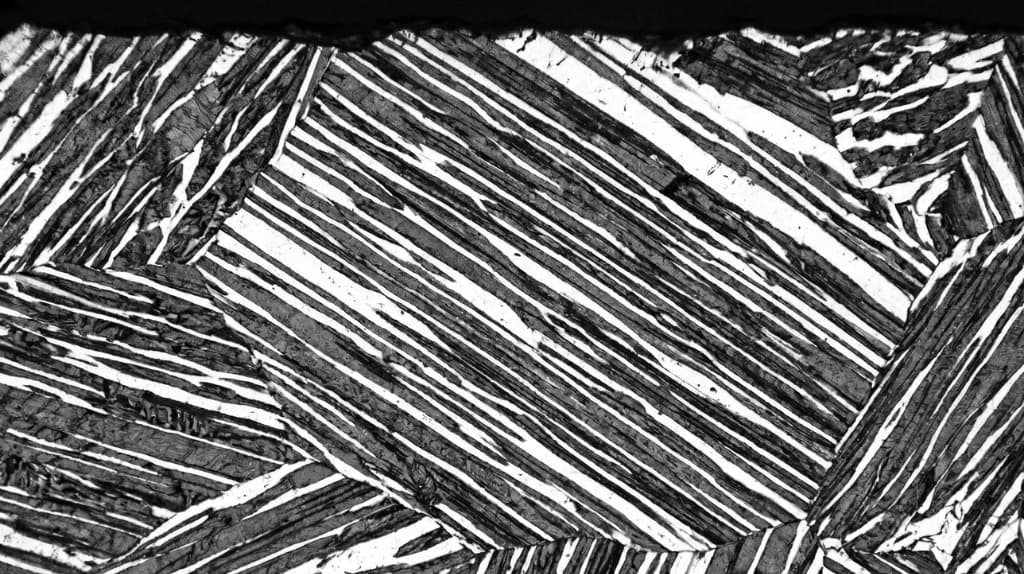
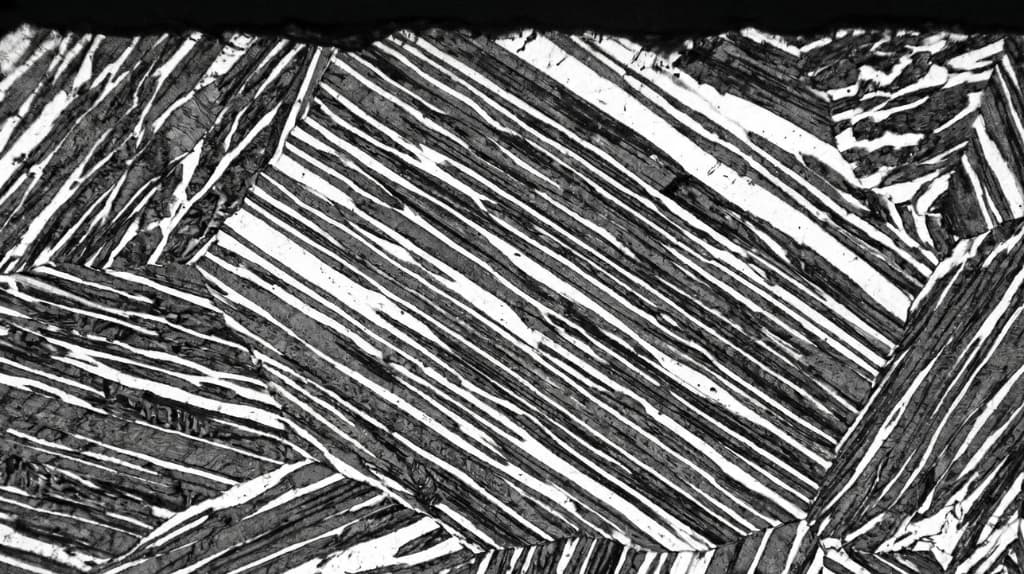
Residual austenite is a key metallurgical phase in heat-treated steels and can significantly influence the mechanical properties and stability of components.
Austenite, referred to as the γ phase of iron, is a face-centered cubic (FCC) crystal structure that forms at high temperatures. During heat treatments, particularly quenching, this phase is expected to transform into martensite. However, a portion may remain “trapped” within the microstructure: this is residual austenite.
Understanding how residual austenite forms, how it can be controlled, and how it is measured is essential in industrial processes, especially because its presence can be critical after quenching and directly affect material performance.
What is residual austenite and why does it form in steels
Residual austenite is the fraction of austenite that does not transform into martensite during the rapid cooling of steels. Austenite forms naturally in steels when they are heated to high temperatures, typically during heat treatments. Under these conditions, the structure of iron transforms into the γ phase, which is stable at high temperatures.
During quenching, rapid cooling induces the transformation of austenite into martensite. However, this transformation is not always complete: a portion of the austenite may remain stable at room temperature, becoming residual austenite.
The amount of residual austenite depends on several factors:
- Carbon content: higher percentages stabilize austenite and increase the retained fraction
- Alloying elements (Ni, Mn, Cr): promote the stability of the γ phase
- Cooling rate: non-optimal cooling may prevent complete transformation
- Component size and geometry: influence thermal gradients and phase transformation
At the core of this phenomenon is the balance between austenite stability and martensitic transformation. When the γ phase is highly stable, a portion remains “retained” even after cooling.
What does austenitic steel mean?
An austenitic steel is a type of steel whose microstructure is predominantly composed of austenite (γ phase) stable at room temperature.
This stability is achieved through the presence of specific alloying elements, such as nickel and chromium, which prevent the transformation of austenite during cooling. A typical example is austenitic stainless steels of the 300 series, widely used for their corrosion resistance and good ductility.
It is important not to confuse this behavior with that of quenched steels.
In austenitic steels:
- austenite is the main and stable phase of the material
- its presence is intentional and designed
In quenched steels, on the other hand:
- austenite forms at high temperature but is expected to transform into martensite during cooling
- the portion that remains is residual austenite, i.e., a phase that has not fully transformed
→ The difference is therefore fundamental:
“in austenitic steels, austenite is a stable and desired condition, whereas in quenched steels it represents a process parameter that must be controlled, as it can influence the mechanical properties and stability of the component.”
Why quantifying residual austenite is essential in quality control
The presence of residual austenite has a direct impact on several material properties and represents a critical parameter in quality control after heat treatment.
Among the main effects:
- Dimensional stability: the transformation of residual austenite over time can cause dimensional changes
Example: a quenched gear may undergo micro-variations in shape during service, affecting fits and tolerances - Fatigue resistance: it can influence component life either positively or negatively
Example: a controlled amount of austenite can improve fatigue resistance, while an excess may promote crack initiation under cyclic loading - Behavior under load: austenite can transform into martensite under deformation (TRIP effect)
Example: under high load conditions, such as in components subjected to impacts or dynamic stresses, this transformation can locally modify mechanical properties - Risk of post-processing deformation: especially in high-precision components
Example: after grinding or finishing operations, the presence of residual austenite may lead to delayed deformation, causing the part to fall out of tolerance
These aspects are particularly relevant in sectors such as:
- Automotive: engine and transmission components, where dimensional stability affects fits and noise levels
- Aerospace: structural parts and critical components, where microstructural variations can compromise safety and reliability
- Gear manufacturing: where tooth profile accuracy and fatigue life under high cyclic loads are essential
- High-responsibility structural components: such as bearings or elements subjected to continuous loads, where even small variations can lead to long-term failures
→ Controlling residual austenite is therefore a fundamental step in post-quenching inspection and process validation, as it ensures stable and predictable performance over time.
How residual austenite is measured using X-ray diffraction
X-ray diffraction (XRD) is the most accurate and reliable method for quantifying residual austenite in steels.
→ Read also: X-ray diffraction: what it is, principles, and XRD applications
The technique is based on the ability to distinguish between the different crystalline phases present in the material.
In particular:
- martensite (α phase) and austenite (γ phase) produce different diffraction peaks
- analysis of peak intensities makes it possible to determine the phase percentages
Quantification is carried out by measuring the characteristic peaks:
- of austenite (e.g., (220) and (311))
- of ferrite/martensite (e.g., (200) and (211))
The use of multiple peaks helps reduce the effects of preferred orientation in the sample and improves measurement accuracy.
The technique is standardized according to ASTM E975-03, which defines the procedures for determining residual austenite in steels with near-random crystallographic orientation.
→ The key principle is:
“crystalline phase analysis → comparison of peak intensities → percentage quantification”
Strumenti GNR per la misura dell’austenite residua
La determinazione quantitativa dell’austenite residua richiede tecniche in grado di garantire elevata sensibilità e precisione, soprattutto quando la fase γ è presente in percentuali molto basse. In molti contesti industriali, infatti, i metodi metallografici tradizionali basati su attacco chimico e analisi ottica non sono sufficienti per ottenere risultati affidabili.
La diffrazione a raggi X (XRD) rappresenta oggi il metodo più accurato per questa applicazione, perché consente di distinguere e quantificare direttamente le fasi cristalline presenti nel materiale.
In questo ambito si collocano strumenti progettati specificamente per l’analisi dell’austenite residua, come:
Entrambi i sistemi si basano sulla misura delle intensità integrate dei picchi di diffrazione caratteristici dell’austenite (ad esempio (220) e (311)) e della ferrite/martensite (ad esempio (200) e (211)). L’utilizzo di più picchi consente di ridurre gli effetti legati all’orientamento preferenziale del campione e di intercettare eventuali interferenze dovute alla presenza di carburi, migliorando l’affidabilità della quantificazione.
Dal punto di vista operativo, questi strumenti sono progettati per consentire una misura rapida e ripetibile della percentuale volumetrica di austenite residua. Il campione viene semplicemente posizionato e l’analisi può essere completata in pochi minuti, con tempi tipici dell’ordine di circa 180 secondi.
Un aspetto particolarmente rilevante è la conformità alla normativa ASTM E 975-03, che rappresenta il riferimento internazionale per la determinazione dell’austenite trattenuta negli acciai con orientamento cristallografico quasi casuale. Questa conformità garantisce la validità dei risultati sia in ambito di ricerca sia nei processi industriali.
Dal punto di vista applicativo, strumenti come AreX D e AreX L trovano impiego sia nelle fasi di sviluppo dei cicli di trattamento termico sia nel controllo qualità in produzione. La possibilità di misurare con precisione anche quantità molto basse di austenite residua (fino a circa lo 0,5%) consente infatti di correlare in modo diretto la microstruttura alle proprietà meccaniche del materiale e di intervenire sui parametri di processo in modo mirato.
In questo senso, la misura dell’austenite residua non è solo un’attività di controllo, ma uno strumento operativo per la gestione e l’ottimizzazione dei processi metallurgici, inclusi quelli più avanzati come la produzione additiva.
GNR instruments for measuring residual austenite
The quantitative determination of residual austenite requires techniques capable of ensuring high sensitivity and precision, especially when the γ phase is present in very low percentages. In many industrial contexts, traditional metallographic methods based on chemical etching and optical analysis are not sufficient to obtain reliable results.
X-ray diffraction (XRD) is currently the most accurate method for this application, as it allows direct identification and quantification of crystalline phases within the material.
In this context, dedicated instruments for residual austenite analysis include:
Both systems are based on the measurement of the integrated intensities of characteristic diffraction peaks of austenite (e.g., (220) and (311)) and ferrite/martensite (e.g., (200) and (211)). The use of multiple peaks helps reduce the effects of preferred orientation and detect potential interferences caused by carbides, improving the reliability of quantification.
From an operational standpoint, these instruments are designed to provide fast and repeatable measurements of the volumetric percentage of residual austenite. The sample is simply positioned, and the analysis can be completed in a few minutes, with typical times of around 180 seconds.
A particularly important aspect is compliance with ASTM E975-03, the international standard for determining retained austenite in steels with near-random crystallographic orientation. This ensures the validity of results both in research environments and in industrial processes.
From an application perspective, instruments such as AreX D and AreX L are used both in the development of heat treatment cycles and in production quality control. The ability to accurately measure even very low amounts of residual austenite (down to approximately 0.5%) makes it possible to directly correlate microstructure with mechanical properties and to adjust process parameters accordingly.
In this sense, residual austenite measurement is not only a control activity, but also an operational tool for managing and optimizing metallurgical processes, including advanced ones such as additive manufacturing.
FAQ
Martensite is a hard and brittle phase that forms during quenching from austenite and is responsible for the high strength and hardness of quenched steels. Residual austenite, on the other hand, is the fraction of austenite that does not transform and remains in the microstructure at room temperature.
These two phases exhibit very different behavior: martensite is stable but brittle, while residual austenite is more ductile and can transform over time or under load. Their presence and balance directly influence the final mechanical properties of the component.
Carbon is one of the elements that most strongly influences austenite stability. A higher carbon content lowers the martensite start temperature (Ms), making complete transformation during quenching more difficult.
As a result, in high-carbon steels, a portion of austenite is more likely to remain untransformed. This aspect must be carefully controlled, as it affects hardness, dimensional stability, and fatigue behavior.
Yes, residual austenite is a metastable phase and can subsequently transform into martensite. This can occur under mechanical loading (plastic deformation), temperature variations, or over time during service.
This transformation may lead to dimensional changes and local variations in mechanical properties, making it essential to control the initial amount of residual austenite in critical components.
An excessive amount of residual austenite can lead to dimensional instability, especially in high-precision components where even small variations can affect performance.
It can also reduce the overall hardness of the material and promote unpredictable behavior under load, such as local transformations that may trigger deformation or changes in performance over time.
Yes, its effect can be both positive and negative. A controlled amount of residual austenite can improve fatigue resistance through the TRIP effect, which allows the material to absorb energy during deformation.
Conversely, excessive or unevenly distributed residual austenite can promote crack initiation and reduce component life, especially under high cyclic loads.
Yes, several methods can be used to reduce residual austenite. The most common is tempering, which promotes microstructural stabilization and can induce secondary transformations.
In some cases, cryogenic treatments are also used, lowering the material to very low temperatures to complete the transformation into martensite. The choice of method depends on the type of steel and the required properties.
Residual austenite control is essential in all sectors where high mechanical performance and long-term stability are required.
These include:
automotive, for engine and transmission components subjected to cyclic loads
aerospace, where reliability and safety are critical requirements
steel industry, for heat treatment control
precision component manufacturing, such as gears and bearings
In these fields, even small microstructural variations can have significant effects on performance.
X-ray diffraction enables direct, non-destructive measurement of the crystalline phases present in a material, clearly distinguishing between austenite and martensite.
Compared to traditional metallographic methods, it offers greater precision and sensitivity, especially for low percentages of residual austenite. In addition, it is standardized by regulations such as ASTM E975-03, ensuring comparable and reliable results in both industrial and research contexts.