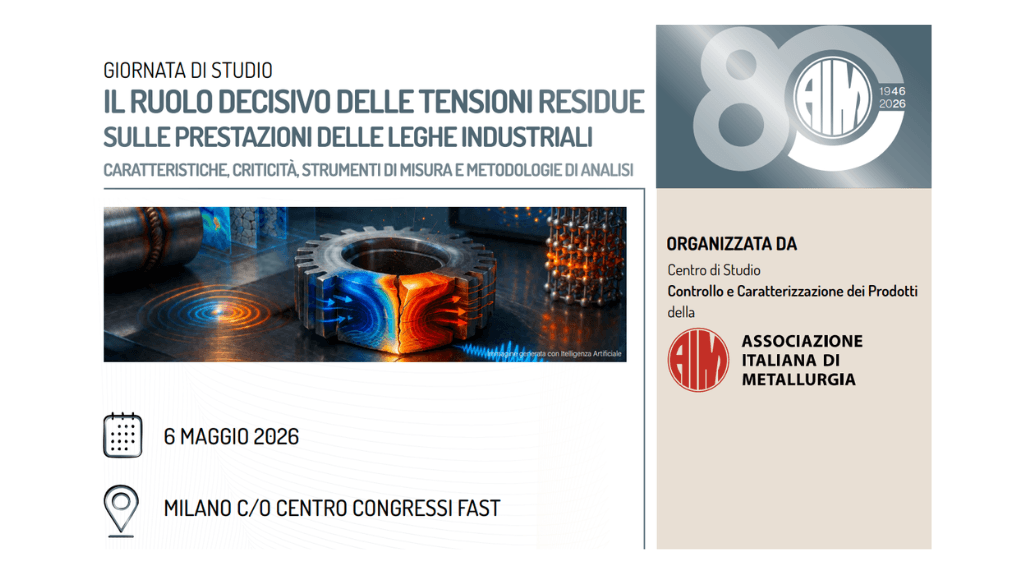
On May 6, 2026, a high-level technical event will take place in Milan, focused on a key topic in materials engineering: residual stresses in industrial alloys.
The event is organized by AIM – the Italian Association for Metallurgy, a leading reference for the Italian metallurgical community, and includes the active participation of GNR, also acting as a coordinator.
In an industrial landscape increasingly oriented toward lightweight structures and high performance, understanding and controlling residual stresses is a critical factor in ensuring the reliability, safety, and durability of components.
AIM event in Milan: focus on residual stresses and measurement techniques
The meeting represents a highly specialized opportunity to explore the characteristics, critical aspects, and analytical methodologies related to the stress state in metallic materials.
Key event details:
- Name: The decisive role of residual stresses on the performance of industrial alloys – Characteristics, critical issues, measurement tools, and analysis methodologies
- Date: May 6, 2026
- Location: FAST – Federation of Scientific and Technical Associations, Piazzale Rodolfo Morandi 2, Milan
- Organizer: AIM – Italian Association for Metallurgy
- Official website: https://www.aimnet.it/
The event will provide a comprehensive overview of currently available measurement tools and methodologies, including techniques such as X-ray diffraction (XRD) and advanced non-destructive solutions.
Particular attention will be given to the comparison between experimental approaches and industrial applications, with the aim of connecting production needs, theoretical models, and laboratory results. The distinctive value of the initiative lies in the integration of industry, research, and academia, fostering a concrete exchange of expertise and real-world case studies.
Who the event is for and why attend
The initiative is aimed at a highly qualified technical audience, involving professionals who work daily in the design, production, and analysis of materials and industrial components:
- Materials and process engineers, engaged in defining and controlling mechanical and structural properties
- Quality and production managers, responsible for ensuring high standards and operational continuity
- R&D professionals, focused on developing innovative solutions and advanced materials
- Researchers, PhD students, and academics, involved in studying analytical methodologies and the physical phenomena behind residual stresses
- Technical and industrial managers, involved in strategic decisions related to performance, reliability, and costs
In an industrial context where residual stresses can lead to premature fatigue failures or unexpected structural breakdowns, participating in the event provides concrete tools to address these challenges with greater awareness and precision.
Reasons to attend include:
- Understanding the origin and impact of residual stresses, analyzing their formation mechanisms and effects on material performance
- Choosing the most suitable measurement technique (XRD, hole drilling, etc.) based on specific industrial applications
- Correctly interpreting data, turning measurements into actionable insights for design and process control
- Optimizing design and processes, reducing defects and improving overall component quality
- Reducing costs and increasing reliability, by proactively addressing structural criticalities
- Promoting quality as a strategic investment, leveraging materials analysis as a long-term competitive advantage
Key players: industry, research, and innovation
One of the distinguishing elements of the event is the strong integration between companies, universities, and research centers, enabling real technology transfer between scientific development and industrial application.
Industrial and technological participants include:
- GNR, an Italian company developing advanced analytical instrumentation for materials analysis, with XRD and OES solutions used worldwide for quality control and metallurgical characterization
- Omega Test, specialized in mechanical testing and structural characterization, supporting companies in performance verification and process validation
- Peenservice, focused on surface treatments, particularly shot peening, to improve fatigue resistance and component durability
- Schaeffler, an international industrial group leader in motion technologies, integrating advanced solutions to optimize performance and reliability in automotive and industrial sectors
- Avio Aero, an aerospace company involved in the design and production of high-performance engine components for critical applications
- Sint Technology, specialized in materials engineering, with advanced expertise in fatigue and residual stress analysis for structural validation
Academic and research contributors include:
- CNR ICMATE, a research institute of the Italian National Research Council focused on the physical and mechanical properties of materials, with advanced activities on microstructure and in-service behavior
- University of Rome Tor Vergata, active in scientific and technological research, contributing to the development of methodologies for residual stress analysis and surface treatments
- Gdansk University (NNT LAB), an international academic institution developing innovative non-destructive techniques for evaluating stress states in metallic materials
- Polytechnic University of Bari, a technical university strongly oriented toward applied research, engaged in industrial process studies and advanced material characterization
This synergy allows the topic of residual stresses to be addressed comprehensively, from theoretical modeling to industrial validation.
GNR’s role in residual stress analysis
Among the event coordinators is Luigi Pisani, Sales Director of GNR, confirming the company’s active role not only in technological development but also in promoting and sharing technical expertise within the industrial and scientific community.
For years, GNR has contributed to the development of advanced technologies for materials analysis, particularly through systems based on X-ray diffraction (XRD) and optical emission spectroscopy (OES), essential tools for the characterization of metal alloys and the evaluation of stress states in components.
These solutions are widely applied in both industrial and research environments, supporting quality control, research and development, and predictive maintenance activities. The ability to obtain reliable and repeatable data enables targeted interventions in production processes, improving performance, safety, and material lifespan.
Participation in the event therefore represents a concrete demonstration of applied expertise and technological leadership, aligned with the needs of an industry increasingly focused on precision, efficiency, and advanced materials management.
A strategic event for the future of materials engineering
Residual stresses are a key factor in ensuring safety, reliability, and innovation in industrial systems. Their proper evaluation makes it possible to prevent structural failures, optimize production processes, and reduce costs related to scrap and maintenance.
The AIM event on May 6, 2026 represents a strategic meeting point between research and industry, offering a concrete opportunity for technical updates and professional exchange.
Participating means gaining useful tools to address current challenges in materials engineering and contributing to a long-term quality-oriented culture.
To explore these topics further and stay updated on advanced technologies, it is possible to follow the activities of GNR and the AIM community.
GENERAL EVENT INFORMATION
EVENT NAME:
The decisive role of residual stresses on the performance of industrial alloys
Characteristics, critical issues, measurement tools, and analysis methodologies
EVENT COORDINATORS:
- Luigi Pisani, Sales Director GNR
- Riccardo Donnini, National Research Council (CNR) – CNR ICMATE, Milan
- Giantonio Toldo, Omega Test
LOCATION:
Milan, FAST – May 6, 2026
ORGANIZER:
AIM – Italian Association for Metallurgy
SPEAKERS AND PARTICIPATING ORGANIZATIONS
GNR
Italian company specialized in the development of advanced analytical instrumentation for materials analysis, including XRD and OES systems, operating globally in quality control and metallurgical characterization.
CNR ICMATE
Research institute of the National Research Council dedicated to the study of materials and their physical and mechanical properties, with advanced research on microstructure and industrial processes.
Omega Test
Company specialized in material testing and inspection, focusing on mechanical testing and structural characterization.
University of Rome Tor Vergata
Italian university active in scientific and technological research, contributing to advanced methodologies for residual stress and surface treatment analysis.
Peenservice
Company specialized in surface treatments, particularly shot peening, to improve fatigue resistance and component lifespan.
Schaeffler
Global industrial group leader in bearing production and motion technology solutions for automotive and industrial applications.
Gdansk University (NNT LAB)
Polish university active in materials research and non-destructive testing techniques for residual stress evaluation.
Avio Aero
Aerospace company specialized in the design and production of aircraft engine components using advanced technologies and high-performance materials.
Polytechnic University of Bari
Technical university focused on engineering and applied research in materials and industrial processes.
Sint Technology
Company specialized in materials engineering and advanced testing, with expertise in fatigue and residual stress analysis.