
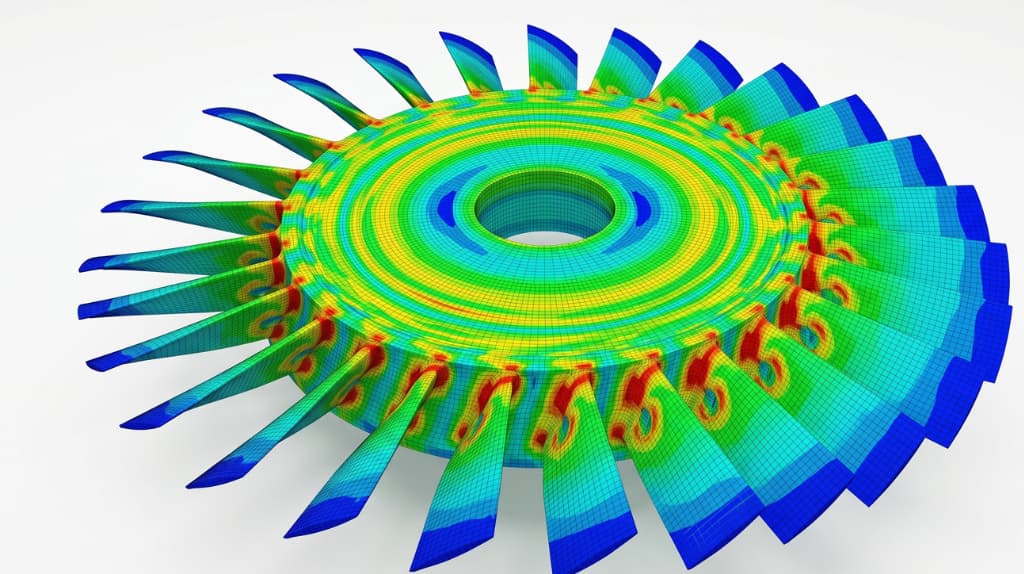
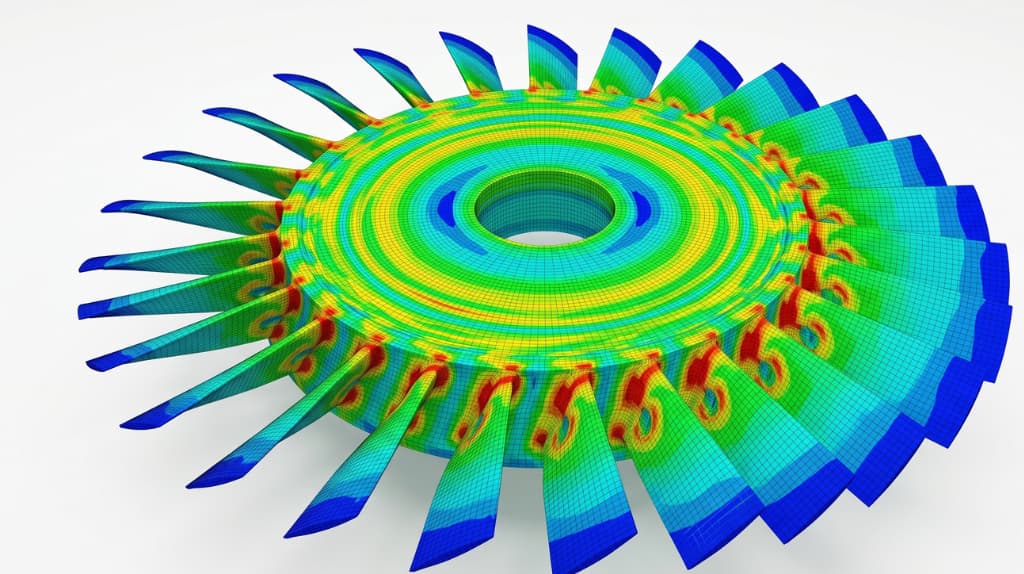
Residual stresses are internal stresses present in a material even in the absence of external loads. They are generated during manufacturing processes and can significantly affect the mechanical performance of metallic components.
Understanding what residual stresses are, how they form, and how to measure them is essential to prevent defects, improve quality, and ensure long-term reliability. In this context, X-ray diffraction (XRD) represents one of the most effective techniques for analyzing the stress state in metals.
What are residual stresses and how do they form in metals
Residual stresses (or residual stress) are internal stresses that remain within a material even when it is not subjected to external forces. Unlike applied stresses, which result from external loads, residual stresses are generated by internal phenomena within the material and can be distributed in a non-uniform way.
The main causes of residual stress formation are:
- Local plastic deformation, which occurs when part of the material exceeds its elastic limit while the rest remains elastic.
Example: during grinding, the surface layer may plastically deform under the action of the tool, while the underlying material remains elastic, generating residual stresses. - Thermal gradients, caused by non-uniform heating or cooling.
Example: in welding, the molten zone cools more slowly than the surrounding areas, creating differences in contraction that generate internal stresses. - Phase transformations, which involve volume changes (e.g., austenite → martensite).
Example: during steel quenching, the transformation to martensite leads to a volume increase that introduces residual stresses into the material. - Structural constraints, which prevent the material from deforming freely.
Example: in a complex or assembled component, certain areas may be constrained by geometry or fittings, preventing free expansion or contraction and causing stress accumulation.
These mechanisms are at the root of residual stress formation in major industrial processes and determine the final stress state of the component.
Residual stresses after machining, welding, and heat treatment
These mechanisms manifest in a wide range of industrial contexts, involving different types of companies and production activities.
In machine shops and companies specialized in machining processes such as turning, milling, or grinding, the combination of surface plastic deformation and heat generates residual stresses in the outer layers of the material, affecting both quality and dimensional stability of the components.
In metal fabrication, industrial welding, and the production of welded structures, localized heating followed by non-uniform cooling introduces high thermal gradients, which are responsible for the formation of often significant residual stresses, especially in welded joints.
Companies specialized in heat treatments, such as quenching and tempering, operate under conditions where residual stresses arise both from differential cooling between the surface and the core of the component and from microstructural transformations involving volume changes.
Finally, companies performing surface treatments, such as shot peening, intentionally introduce residual stresses in a controlled manner. In this case, compressive surface stresses are used to improve fatigue resistance and overall component performance.
In all these applications, the material retains an internal stress state that can significantly influence its behavior during service, making the control and measurement of residual stresses essential throughout the entire production cycle.
How to measure residual stresses using X-ray diffraction
Residual stresses can be measured using various techniques, but X-ray diffraction (XRD) is one of the most reliable and widely used methods for surface analysis.
Read also the article on XRD principles and applications
The principle behind this technique is the relationship between macroscopic stress and microscopic deformation of the crystal lattice. When a material is subjected to stress, the فاص distance between crystallographic planes changes. This variation is known as lattice strain. The change in interplanar spacing causes a shift in the diffraction peaks. By analyzing this shift, it is possible to obtain information about the stress state of the material.
The most commonly used approach is the sin²ψ method, which involves measuring the position of diffraction peaks while tilting the sample at an angle ψ. By varying the tilt angle, changes in interplanar spacing are observed and the residual stress values can be determined. This technique allows for direct surface measurement without damaging the sample.
In practical terms:
- tensile stress tends to increase the spacing between crystallographic planes
- compressive stress tends to reduce it
These variations are reflected in the XRD signal and make it possible to distinguish between different stress states.
Residual stresses and the proportional limit of the yield strength
To understand the impact of residual stresses, it is necessary to consider the mechanical behavior of the material. The proportional limit of the yield strength represents the point beyond which the material transitions from elastic to plastic behavior. In the elastic range, the material returns to its original shape once the load is removed; in the plastic range, deformation becomes permanent.
When residual stresses are high, they can locally bring the material closer to this limit, increasing the risk of exceeding the elastic range even under relatively low external loads. This has a direct impact on fatigue performance: a material already “pre-loaded” by tensile residual stresses is more susceptible to crack initiation and propagation.
For this reason, understanding and controlling residual stresses is essential to prevent structural failures and ensure component safety.
GNR instruments for measuring surface residual stresses
GNR has long been committed to developing advanced solutions for residual stress measurement, with an approach based on X-ray diffraction applied directly in industrial environments. The goal is to provide reliable, flexible instruments that can be used both in the laboratory and in the field, supporting quality control and the prevention of structural failures.
For the measurement of surface residual stresses, GNR offers dedicated instruments:
Both systems enable non-destructive analysis based on X-ray diffraction, allowing direct determination of the stress state in metallic materials.
EDGE is a portable Theta/Theta diffractometer capable of performing reliable analysis not only of residual stresses, but also of retained austenite and phases present in alloys. Thanks to its compact configuration—based on a low-power X-ray tube and a fast, efficient detector—it provides accurate measurements in a short time. It can be used both in the laboratory and directly in the field, making it particularly suitable for applications on real components and large structures.
Stress X is an X-ray diffractometer dedicated to residual stress analysis and stands out for its integration with a 6-axis anthropomorphic robot, enabling the analysis of samples of any size and shape, including complex geometries. This configuration allows access to hard-to-reach measurement points while maintaining high repeatability, with positioning accuracy down to a few microns.
Why residual stress measurement is strategic in high-responsibility sectors
Residual stress measurement is a key factor in high-responsibility industries, where the safety and reliability of components are critical and must be ensured throughout the entire product lifecycle.
- In industrial applications, stress state control is used across a wide range of operational contexts. In the automotive sector, for example, it is essential for verifying critical components such as gears, crankshafts, connecting rods, and camshafts, where residual stresses directly influence fatigue resistance and long-term durability. Similarly, it is used to analyze the behavior of springs, alloy wheels, and other elements subjected to cyclic loads.
- In manufacturing processes, residual stress measurement makes it possible to evaluate the effects of operations such as machining, rolling, or deep drawing, contributing to process parameter optimization and improved mechanical performance of components. It is also an essential tool for assessing the effectiveness of surface treatments such as shot peening, where introduced compressive stresses have a direct impact on fatigue resistance.
- In metallurgical and production environments, residual stress analysis is also used to control the quality of castings, such as iron or aluminum components, and to evaluate stress induced by welding processes, including high-energy techniques such as laser and electron beam welding.
- In the energy and infrastructure sectors, measuring operational stress in gas pipelines and large tensioned structures enables monitoring of material behavior under real conditions, helping identify potential issues before they develop into structural failures.
Finally, in highly specialized fields such as aerospace and defense, residual stress analysis allows the identification of critical areas after service loading and enables correlation between stress state and component performance. In these contexts, the determination of retained austenite in components such as bearings or injection systems is also a key factor in overall material assessment.
In all these cases, residual stress measurement makes it possible to:
- prevent defects and structural failures
- increase component fatigue life
- improve quality control
- validate and optimize production processes
In an increasingly advanced industrial environment, the scientific monitoring of residual stresses therefore becomes an essential tool to ensure structural reliability, operational safety, and long-term performance stability.
Surface residual stresses affect the outermost layers of a material and are often related to machining or surface treatments. Deep residual stresses develop within the bulk of the material and are typically associated with processes such as heat treatment or solidification.
Tensile residual stresses promote crack initiation and propagation, reducing fatigue strength. In contrast, compressive surface stresses can improve fatigue resistance and increase component lifespan.
Yes, they can be reduced through stress-relief heat treatments, controlled mechanical processes, or specific techniques designed to rebalance the material’s stress state.
Tensile stresses are more critical because they facilitate crack propagation and material failure. Compressive stresses, on the other hand, can have a beneficial effect on mechanical strength.
Welding involves intense localized heating followed by non-uniform cooling. This creates high thermal gradients that generate significant residual stresses.
The main sectors include automotive, aerospace, energy, and infrastructure, where controlling residual stresses is essential to ensure safety, quality, and component durability.