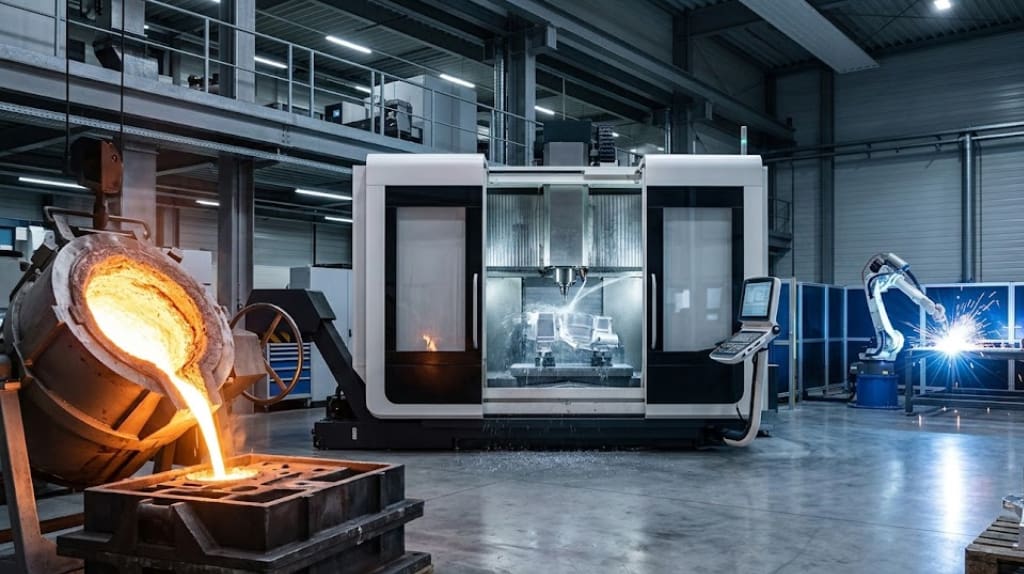
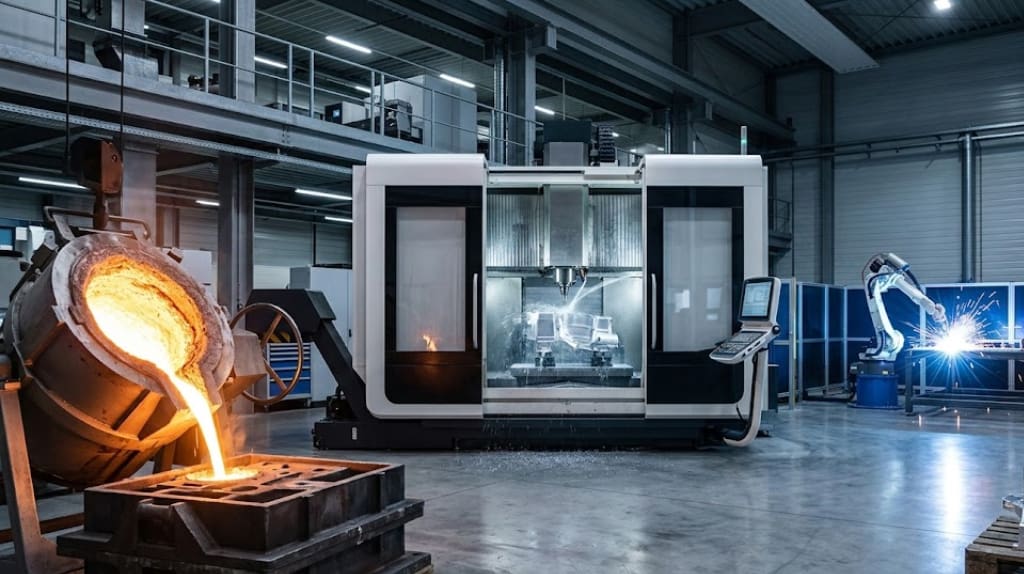
Metalworking includes all the industrial processes used to transform a raw metallic material into a finished component or a semi-finished product intended for subsequent production stages. It is a core activity within the manufacturing industry and is widely used in sectors such as automotive, aerospace, energy, construction, mechanical engineering and industrial plant manufacturing.
These processes make it possible to modify the shape, dimensions, mechanical properties and surface characteristics of a metal according to its final application. Depending on the required result, the material can undergo different types of transformation.
One of the most important principles involved is plastic deformation, meaning the ability of a metal to permanently change shape under the action of a force without breaking. This occurs, for example, in rolling, stamping and forging processes.
Another major category is material removal machining, in which part of the metal is removed through cutting tools or abrasive processes to achieve precise geometries and controlled dimensional tolerances. Turning, milling and grinding are some examples of this type of machining.
Alongside mechanical processes, there are also thermal transformations, which use heat to modify the internal structure of the material and improve properties such as hardness, strength, elasticity and toughness. Heat treatments such as quenching, tempering and annealing are widely used in industrial metallurgy.
Metalworking therefore does not refer to a single technique, but to a complex set of complementary production processes that make it possible to obtain reliable, high-performance metal components suitable for modern manufacturing requirements.
H2: Main stages of metalworking
Metalworking develops through a sequence of production stages that may vary depending on the material used, the characteristics required for the final component and the target industrial sector. Each process contributes to defining the shape, mechanical properties, dimensional accuracy and surface quality of the product.
The production cycle begins with the preparation of the raw metallic material, which may come in the form of ingots, billets, bars, coils, sheets or metal powders. During this stage, operations such as selection, cutting, preheating and verification of the material’s chemical composition are carried out to ensure consistency and control throughout the production process.
In many cases, the metal then undergoes melting and casting processes, in which the material is brought to a liquid state and subsequently poured into molds or continuous casting systems. This stage makes it possible to obtain semi-finished products or components already close to their final shape, reducing the need for subsequent machining operations. Depending on the application, different techniques may be used, including sand casting, die casting and continuous casting.
One of the most important stages involves plastic deformation processes, which modify the geometry of the metal by exploiting its ability to permanently deform under mechanical forces. This category includes processes such as rolling, extrusion, stamping and forging, all widely used in industrial manufacturing.
These operations can be performed either hot or cold. In hot working, the material is heated to increase its formability and reduce the forces required for processing. Cold working, on the other hand, is carried out at room temperature and makes it possible to achieve greater dimensional accuracy, improved surface finish and, in many cases, increased material hardness due to work hardening.
Whenever precise geometries and tight tolerances are required, manufacturers rely on chip removal machining, in which part of the material is removed through controlled cutting tools. The most common operations include turning, milling, drilling, boring and grinding, used to produce mechanical components with high precision and repeatability.
Joining processes are instead used to assemble two or more metallic elements into a stable and resistant structure. The most widespread method is welding, which joins materials through localized melting of the edges to be connected. Alternative techniques such as brazing may also be employed, using a filler material with a lower melting temperature than the base metals.
After mechanical processing, components may undergo heat treatments to modify the material’s microstructure and improve its mechanical properties. Processes such as quenching, tempering, annealing and normalizing make it possible to improve hardness, toughness, wear resistance and dimensional stability. Alongside heat treatments, manufacturers often apply surface treatments such as galvanizing, anodizing, painting or technical coatings to enhance corrosion resistance as well as aesthetic or functional properties.
The final stage involves metal finishing and final quality control. During this phase, operations such as deburring, polishing and verification of the component’s dimensional, mechanical and metallurgical characteristics are performed. Quality checks may include chemical analysis, mechanical testing and non-destructive testing techniques, all essential for ensuring compliance with technical specifications and the reliability of the finished product.
Machinery used in metalworking processes
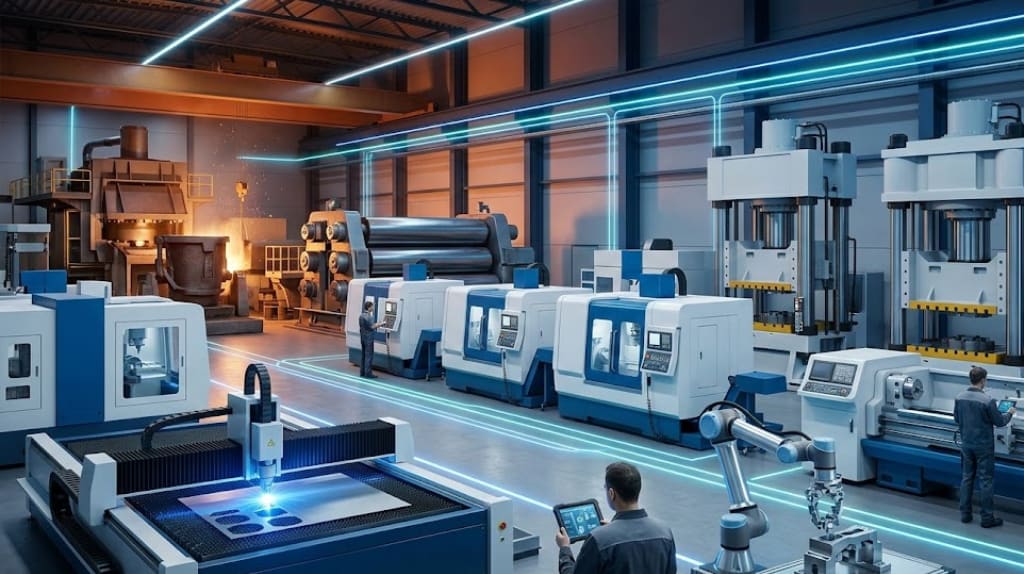
Modern metalworking processes rely on industrial machinery designed to ensure precision, productivity and process repeatability. The choice of technology depends on the type of operation, the material being processed, production volumes and the required level of automation.
Among the most widely used machines are traditional lathes and CNC lathes, mainly employed for machining cylindrical or rotating components. In traditional systems, many operations are manually controlled by the operator, while Computer Numerical Control (CNC) lathes automate the process, improving machining precision, speed and repeatability.
Alongside lathes, CNC machining centers are also widely used. These multifunctional machines can perform operations such as milling, drilling, boring and tapping within a single production cycle. Thanks to digital control systems and the ability to program complex tool paths, these machines are now considered one of the key elements of advanced mechanical manufacturing.
In plastic deformation processes, manufacturers instead use mechanical presses and hydraulic presses for operations such as stamping, bending, blanking and deep drawing. Mechanical presses are generally faster and better suited to high-volume production, while hydraulic presses allow more precise control of the applied force and are often used for more complex operations or high-strength materials.
For the production of sheets, bars and profiles, rolling mills play a fundamental role. These systems deform the material by passing it between opposing rollers. Rolling can be performed either hot or cold depending on the characteristics required for the final product.
In cutting and shaping operations, laser and plasma systems are increasingly widespread due to their ability to perform fast and highly precise machining. Laser cutting enables very accurate geometries and clean finishes even on thin materials, while plasma cutting is commonly used for thicker materials and high-productivity industrial applications.
Melting systems represent the core of foundry operations. Industrial furnaces, casting systems and automated lines make it possible to bring metal to a liquid state and transform it into castings or semi-finished products intended for subsequent machining stages.
Modern production lines also increasingly rely on industrial robots, used for tasks such as welding, handling, assembly, loading and unloading parts, and quality control. The use of robotics improves operational continuity, safety and standardization throughout the production process.
The technological evolution of metalworking is now closely linked to the principles of Industry 4.0, based on automation, interconnectivity and digital data management. Modern machinery can communicate with one another, collect real-time information and integrate with production management software and monitoring systems.
This digital integration makes it possible to optimize production times, energy consumption, maintenance and product quality, supporting increasingly efficient, traceable and process-oriented manufacturing systems.
Most commonly used metals in industrial manufacturing
Industrial metalworking processes involve materials with very different characteristics, selected according to the performance required for the final component. Properties such as mechanical strength, hardness, weight, thermal and electrical conductivity, corrosion resistance and machinability directly influence the choice of metal used across different industrial sectors.
Steel is the most widely used material in the metallurgical industry thanks to its high versatility. Carbon steels are employed in numerous structural and mechanical applications because of their good balance between strength, cost and workability. Alloy steels, on the other hand, contain additional elements such as chromium, nickel, molybdenum or vanadium, which improve specific properties including hardness, wear resistance, toughness and high-temperature performance. For this reason, they are extensively used in the automotive, energy, aerospace and industrial machinery sectors.
Aluminum is mainly chosen for its light weight and excellent strength-to-weight ratio. It is also corrosion-resistant and easy to machine, making it particularly common in transportation, construction, aerospace and technical component manufacturing. In addition, aluminum alloys can provide different mechanical properties depending on the specific application requirements.
Copper is especially valued for its high electrical and thermal conductivity. As a result, it is one of the most widely used materials for electrical components, cables, heat exchangers and industrial systems. In addition to its conductive properties, copper offers good corrosion resistance and high ductility, which facilitate processing and forming operations.
Titanium is used in highly specialized applications thanks to its combination of high mechanical strength, low weight and excellent corrosion resistance. It is particularly common in aerospace, biomedical, energy and chemical industries, where high performance is required even under severe operating conditions. Compared to other metals, titanium involves higher costs and greater machining complexity, but it provides major advantages in terms of reliability and durability.
Alongside traditional materials, special alloys are increasingly being developed to meet specific technical requirements. Nickel-based superalloys, cobalt alloys and other high-performance materials are used in turbines, aircraft engines, energy systems and applications involving high temperatures or highly corrosive environments. These materials are engineered to maintain structural stability and mechanical properties even under extreme conditions.
The choice of material is therefore one of the most important aspects of the entire production process, since it affects not only the final performance of the component, but also the manufacturing technologies, subsequent treatments and quality control procedures required during production.
Chemical composition control in metalworking processes
In modern metallurgical processes, controlling the chemical composition of metals is essential to ensure the quality, reliability and compliance of the final product. Even small variations in the percentage of elements contained within an alloy can significantly affect its mechanical properties, machinability and behavior during production processes.
For this reason, chemical composition verification is carried out at several stages throughout the industrial cycle, starting with the inspection of the raw metallic material. Before processing begins, it is essential to verify that the received material complies with the required specifications and that the alloy contains the correct concentrations of elements such as carbon, manganese, chromium, nickel, molybdenum or aluminum, depending on the application.
Chemical control also continues throughout the production process, especially during melting, casting and alloy production operations. During these stages, the composition of the molten metal bath must be constantly monitored in order to maintain production stability and reduce the risk of non-conformities or metallurgical defects.
Final quality control also requires precise verification of the material’s composition, particularly in highly specialized industrial sectors where components must comply with strict technical standards and deliver consistent performance over time.
To perform these analyses, OES spectrometry (Optical Emission Spectrometry) is widely used, as it is one of the most common technologies for elemental analysis of metals. This method makes it possible to quickly identify and quantify the chemical elements present in a metallic alloy by analyzing the light emitted by the material during a controlled electrical discharge.
OES spectrometry enables fast, accurate and repeatable testing on both ferrous and non-ferrous materials, supporting companies in raw material verification, production process monitoring and final quality certification of metal components.
In an industrial environment increasingly focused on precision, traceability and standardization, chemical composition control has therefore become an integral part of the entire metalworking process.
GNR instruments for quality control in metalworking
In the metalworking industry, fast and accurate control of chemical composition is essential to ensure product quality, production continuity and material compliance. In this context, Optical Emission Spectrometry (OES) represents one of the most widely used technologies for the elemental analysis of metallic alloys.
An OES metal spectrometer makes it possible to identify and quantify the elements contained in the material, supporting activities such as:
- incoming material inspection
- casting and production process control
- compliance with technical specifications and standards
- quality traceability throughout the entire production cycle
Thanks to the precision of the method and the short analysis times, OES spectrometry is an effective quality control solution for foundries, metallurgical industries, mechanical workshops and companies specialized in metalworking.
To meet different operational requirements, GNR offers a complete range of OES spectrometers for metal analysis, designed for laboratory applications, quality control and on-site production verification.
The S1 MiniLab 150 is a compact solution developed for quality control activities and rapid laboratory analyses, offering a good balance between ease of use and analytical performance.
The S3 MiniLab 300 expands analytical capabilities with a more advanced configuration, suitable for metallurgical laboratories and production environments requiring greater flexibility in alloy analysis.
The S6 Sirius 500 is a high-performance spectrometer based on CMOS technology, designed to provide high acquisition speed, wide elemental coverage and advanced analytical precision on both ferrous and non-ferrous materials.
For applications requiring operational mobility, GNR offers the portable spectrometers E3 Esaport and E4 Esaport Plus, developed to perform inspections directly in production areas, on large components or in locations where sample transportation is impractical. These instruments enable rapid material verification, batch inspection and alloy sorting directly on-site.
The S5 Solaris Plus is designed for laboratories and industrial facilities requiring advanced analytical performance, extensive configurability and sophisticated metallurgical analysis management.
The S7 Metal Lab Plus represents the most comprehensive solution in the GNR range for OES metal analysis, developed for highly specialized applications where maximum accuracy, analytical stability and advanced metallurgical quality control are required.
With a complete range of benchtop and portable instruments, GNR supports companies in the industrial metallurgy and metalworking sectors by controlling chemical composition throughout every stage of the production process, helping to reduce errors, scrap and rework.
Main industries using metalworking processes
Metalworking is at the core of numerous industrial sectors where the reliability, precision and performance of components are critical factors. Each industry requires specific materials, production technologies and quality control procedures, often governed by strict technical standards.
In the automotive industry, metalworking processes are used to manufacture structural components, engines, transmissions, braking systems and mechanical parts subjected to high stress. In this field, dimensional accuracy and control of metallurgical properties are essential to ensure vehicle safety, durability and reliability.
The aerospace industry requires even higher levels of precision and quality control. Components intended for aircraft, turbines or aerospace systems must provide high mechanical strength, low weight and stability even under extreme operating conditions. For this reason, special alloys and highly controlled manufacturing processes are widely used.
In the energy sector, metalworking plays a central role in the production of turbines, power generation systems, heat exchangers, valves, pipelines and components for power plants and industrial facilities. In these applications, materials must withstand high temperatures, high pressures and corrosive environments.
The construction industry also makes extensive use of processed metal components for structural frameworks, steel fabrication, infrastructure, industrial systems and reinforcement applications. The quality of metalworking directly affects the stability and safety of buildings and structures.
In the Oil & Gas sector, metalworking operations must guarantee high operational reliability under often critical conditions. Pipelines, flanges, valves, pressure vessels and components for extraction platforms and processing plants are exposed to severe mechanical stress, corrosion and temperature variations, making rigorous quality control of both materials and manufacturing processes essential.
The production of industrial machinery is another field strongly connected to metalworking. Automated machines, production systems, tools and mechanical assemblies require highly precise components to ensure efficiency, operational continuity and reduced wear over time.
Across all these industries, manufacturing precision is not only a production requirement but also directly impacts the safety, performance, reliability and durability of metal components. For this reason, advanced manufacturing technologies and accurate control of chemical composition and metallurgical properties are essential throughout the entire production cycle.
.
Recent innovations in metalworking
The metalworking industry is undergoing a major technological transformation driven by automation, digitalization and sustainable manufacturing processes. According to the Metalworking Equipment Market Report published by Grand View Research, the growth of the sector is mainly supported by the increasing demand for advanced CNC machinery, digital integration of production lines and the expansion of industries such as automotive and aerospace, which require ever-higher levels of precision and productivity.
One of the most significant developments is the widespread adoption of industrial automation systems and increasingly advanced CNC machines. Modern lathes, milling machines, presses and machining centers are now integrated with production management software and real-time data collection systems, enabling more accurate process control and a significant reduction in production errors.
Industrial robotics is also playing an increasingly important role in metalworking operations. The World Robotics Report published by the International Federation of Robotics (IFR) highlights continuous growth in the use of industrial robots within metalworking production lines, including a significant increase in collaborative robots (cobots) designed to work alongside operators in welding, assembly, handling and quality control applications.
Technological innovation also involves the digital management of manufacturing processes. In a study focused on digital manufacturing, McKinsey emphasizes the growing impact of technologies such as IoT, digital twins, artificial intelligence and predictive maintenance in industrial production environments. These tools make it possible to monitor machine conditions in real time, predict failures, reduce downtime and optimize both quality and manufacturing efficiency.
At the same time, the industry is increasingly investing in the sustainability of metalworking processes and the reduction of environmental impact in metallurgy. The Iron and Steel Technology Roadmap published by the International Energy Agency (IEA) highlights how the future of the steel industry depends on low-emission technologies, improved energy efficiency, electrification of production systems and the use of hydrogen in steelmaking processes.
The World Steel Association, through its Sustainability Indicators, also underlines the growing importance of topics such as CO₂ emission reduction, increased recycling of metallic materials and the development of circular economy-oriented production models. The objective is to improve sustainability throughout the entire production cycle without compromising material quality, strength or performance.
Metalworking is therefore evolving into an increasingly digital, automated and sustainable manufacturing ecosystem, where advanced technologies, quality control and intelligent data management become essential tools for improving competitiveness, precision and industrial efficiency.
FAQ
Metalworking includes all the industrial processes used to transform raw metal into a finished component or a semi-finished product. These processes can modify the material’s shape, dimensions, mechanical properties and surface characteristics through mechanical, thermal or chemical operations.
The main industrial metalworking processes include melting, casting, rolling, stamping, extrusion, turning, milling, drilling, welding and heat treatments. Each process is selected according to the material used and the characteristics required for the final component.
Metalworking uses a wide range of industrial machinery, including CNC lathes, machining centers, mechanical and hydraulic presses, rolling mills, laser and plasma systems, melting furnaces and industrial robots. Modern production lines often integrate automation and digital control systems based on the principles of Industry 4.0.
In hot working, the metal is heated before deformation in order to improve formability and reduce the mechanical forces required during processing. Cold working, on the other hand, is carried out at room temperature and allows greater dimensional accuracy, improved surface finish and a possible increase in material hardness due to work hardening.
Quality control procedures may include dimensional inspections, mechanical testing, non-destructive testing and chemical composition analysis. These controls are essential to ensure compliance with technical specifications, component reliability and process stability throughout production.
An OES spectrometer is used to analyze the chemical composition of metallic alloys during different stages of production. It can be employed to verify incoming materials, monitor composition during melting and casting, sort alloys and confirm final product compliance through fast and accurate analysis of the elements contained in the metal.