
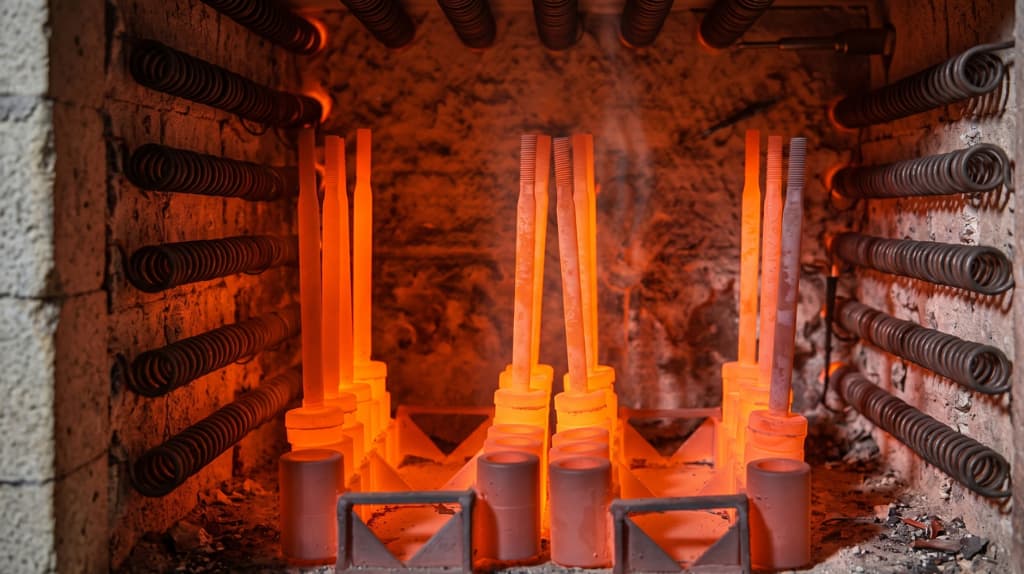
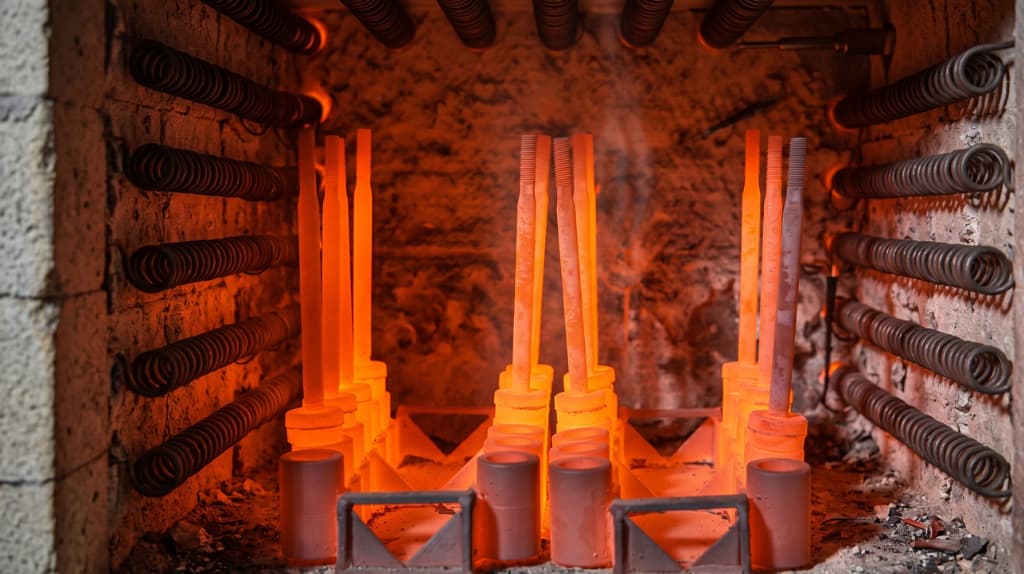
Thermal stress is the set of internal stresses that develop in a material when it is subjected to non-uniform temperature variations or to conditions that prevent its free deformation.
In metals, this phenomenon is particularly relevant because it can lead to permanent deformation, crack formation, and a reduction in mechanical strength. For this reason, thermal stress represents a critical aspect in metallurgical processes, especially when intense or repeated thermal cycles are involved.
Understanding how it is generated and how it is distributed within the material is fundamental to ensuring the quality and reliability of components. In this context, X-ray diffraction (XRD) makes it possible to accurately analyze the effects of thermal stress, both in terms of microstructure and residual stresses.
Who Needs Thermal Stress Analysis
Thermal stress analysis is relevant for all companies that design, produce, or use metal components subjected to thermal cycles, mechanical processing, or critical operating conditions.
In particular, it concerns:
- Automotive companies and their suppliers
manufacturers of components such as crankshafts, connecting rods, camshafts, gears, springs, and alloy wheels, where residual stresses directly influence reliability and durability - Mechanical industry and machine construction
companies producing machined parts or structural components subjected to dynamic loads, where optimizing processing parameters is essential - Foundries and metal processing companies
producers of cast iron or aluminum parts and companies performing processes such as deep drawing, rolling, and shot peening, where thermal stress and residual stresses affect final part quality - Welding and advanced fabrication companies
companies working with laser or electron beam welding that must ensure the integrity of joints and structures - Energy and infrastructure sector
operators managing gas pipelines, plants, and large tensioned structures, where it is essential to monitor operational stress directly during service - Aerospace and defense
companies developing high-performance components and identifying critical areas after the application of loads or intensive operating cycles - Manufacturers of high-precision components
such as bearings and injection systems, where the control of retained austenite and residual stresses is crucial for performance
In all these cases, analyzing thermal stress means preventing defects, improving quality, and increasing component lifetime, while reducing operational risks and maintenance costs.
What Thermal Stress in Metals Is and How It Develops
Thermal stress is generated when a metal material undergoes temperature variations that produce non-uniform deformation.
At the basis of the phenomenon there are three main factors.
Thermal expansion is the first element: all metals expand when heated and contract when cooled. If this variation occurs in a non-uniform way, internal stresses are generated.
The second factor is represented by temperature gradients. When one part of a component is hotter than another—for example, the surface compared to the core—the different zones deform differently, generating a stress state.
The third element concerns mechanical constraints. If the material cannot deform freely due to the geometry of the part or assembly conditions, stresses accumulate instead of being dissipated.
This phenomenon is very common in industrial environments. It occurs, for example, in the rapid cooling of steel components, in welding processes, in the solidification of metals in foundry operations, or in components subjected to repeated thermal cycles. In all these cases, thermal stress can compromise material quality and durability.
Thermal Stress in Industrial Heat Treatments
In industrial heat treatments, thermal stress is closely related to the heating and cooling cycles to which the material is subjected.
Processes such as quenching, tempering, or non-uniform cooling generate conditions in which strong temperature gradients develop. In particular, during quenching, the surface of the material cools much more rapidly than the inner part, creating a difference in deformation between the various zones.
To these effects are added microstructural transformations. The transformation from austenite to martensite, typical of quenched steels, involves volume changes that contribute to the formation of internal stresses.
When these stresses exceed the elastic limit of the material, plastic deformation occurs, which can lead to permanent distortions or the formation of defects.
In this context, the relationship is clear: the thermal cycle induces changes in the microstructure, and these changes result in the formation of residual stresses. Understanding this relationship is fundamental for the control of metallurgical processes.
How X-ray Diffraction Analyzes the Effects of Thermal Stress
X-ray diffraction makes it possible to analyze the effects of thermal stress by directly observing the behavior of the crystal lattice of the material.
When a material is subjected to stress, the distance between crystallographic planes changes. This variation is known as lattice deformation and forms the basis of XRD analysis.
The modification of the interplanar spacing causes a shift in diffraction peaks. In the presence of tensile or compressive stress, the peaks shift from their original position, providing a direct indication of the stress state of the material.
To quantify these stresses, the sin²ψ method is used. This method allows the measurement of lattice deformation along different directions and enables the calculation of residual stresses with good accuracy.
The principle can be summarized as follows:
stress → lattice deformation → peak shift → XRD analysis
Another key aspect is the correlation between microstructure and stress state. XRD makes it possible to relate phase transformations to the residual stresses generated, providing a complete understanding of thermal stress effects.
Phase Analysis and Microstructural Control with GNR Diffractometers
The analysis of thermal stress effects in metals does not rely on a single instrument, but on different and complementary approaches, each addressing a specific aspect of the material.
On one side, there are instruments dedicated to phase analysis and microstructural control, which are essential for understanding how thermal cycles have modified the structure of the metal. On the other side, there are systems designed for the measurement of residual stresses, used to directly quantify the stress state left by the thermal process.
The first group includes GNR diffractometers:
→ Discover the full range: https://gnr.it/gnr_products/category/x-ray-diffraction/
These instruments are used to study phase transformations and support microstructural control after heat treatments, rapid cooling, or other processes that may alter the internal equilibrium of the material.
In particular, AreX D is optimized for phase analysis, is compliant with ASTM E 975-03, and is used for the determination of retained austenite, a key parameter for evaluating the effects of heat treatment and the stability of the material.
It is important to specify that AreX systems are not dedicated instruments for direct residual stress measurement. Their role is to provide insight into the microstructure and the transformations induced by thermal cycles.
This approach is complemented by GNR systems dedicated to residual stress measurement:
These instruments make it possible to measure residual stresses in metallic materials, both in laboratory environments and directly on real components.
The integration of these approaches enables a complete analysis:
- AreX D and AreX L identify microstructural transformations
- Stress X and EDGE quantify residual stresses
→ making it possible to directly link:
thermal cycle → microstructure → stress state
This integrated approach represents a key element for quality control in advanced metallurgical processes.
Why Thermal Stress Control Is Strategic in the Metallurgical Industry
Thermal stress control is a strategic factor in many industrial sectors, where material performance must be guaranteed over time and under often critical operating conditions.
In the automotive sector, for example, residual stresses are monitored in components such as camshafts, connecting rods, crankshafts, and equalizers, where even small variations in the stress state can affect reliability and service life. Similarly, analysis is essential for gears and springs—both coil and leaf types—subjected to cyclic loads and repeated stresses.
In industrial production, thermal stress control is crucial in forming and machining processes. This includes residual stresses induced by deep drawing, typical of household appliances and structural parts, as well as machining processes involving material removal, where optimizing process parameters helps improve the mechanical resistance of components.
An equally important role is found in surface treatments and performance-enhancing processes, such as shot peening and rolling. In these cases, residual stress measurement makes it possible to evaluate the effectiveness of the treatment and its contribution to fatigue resistance.
In the energy and infrastructure sector, the focus shifts to large components and systems in operation. Measuring operational stress in gas pipelines or large tensioned structures allows the condition of the material to be monitored directly under real working conditions, making it possible to identify potential issues before they develop into structural problems.
Thermal stress also plays a key role in casting and welding processes. The detection of residual stresses in cast components, such as cast iron parts of machine tools or aluminum components, allows evaluation of production quality. Similarly, the analysis of stress induced by welding—both laser and electron beam—is essential to ensure the integrity of joints.
In highly specialized fields such as aerospace and defense, residual stress analysis is used to identify critical areas after the application of working loads, contributing to the safety and reliability of components.
Finally, microstructural analysis integrates with these applications through the determination of retained austenite, for example in bearings or diesel injector components, and through studies correlating residual stresses with mechanical resistance, such as in aluminum alloy wheels.
In all these contexts, the principle remains the same:
microstructural control and stress state = safety, quality, and component durability
With the evolution of materials and production processes, which are becoming increasingly complex and high-performing, it is therefore essential to adopt advanced analysis techniques. The combination of phase analysis and residual stress measurement, made possible by X-ray diffraction, represents today a fundamental tool for advanced metallurgical control.
FAQ
The main causes of thermal stress are temperature gradients, mechanical constraints, and non-uniform cooling. When different parts of a component expand or contract at different rates, internal stresses develop.
In addition, phase transformations during heat treatment—such as the transformation from austenite to martensite—can significantly contribute to stress formation due to associated volume changes. These combined effects make thermal stress a common issue in many industrial processes.
Quenching generates high residual stresses because of rapid cooling and the resulting temperature gradients between the surface and the core of the material. At the same time, microstructural transformations increase internal stress levels.
Tempering is used after quenching to reduce these stresses. It allows partial relaxation of the internal stress state and improves the material’s toughness and dimensional stability, making the component more reliable in service.
Thermal stress refers to the stress generated during temperature changes, especially when expansion or contraction is not uniform or is constrained.
Residual stress, on the other hand, is the stress that remains in the material after the thermal or mechanical process has ended. In other words, thermal stress is the cause, while residual stress is the result.
Retained austenite affects both mechanical properties and dimensional stability of the material. If present in excessive amounts, it can lead to unexpected transformations over time or under load.
By analyzing retained austenite, it is possible to evaluate the effectiveness of the heat treatment and predict how the component will behave during operation, especially in terms of fatigue resistance and dimensional accuracy.