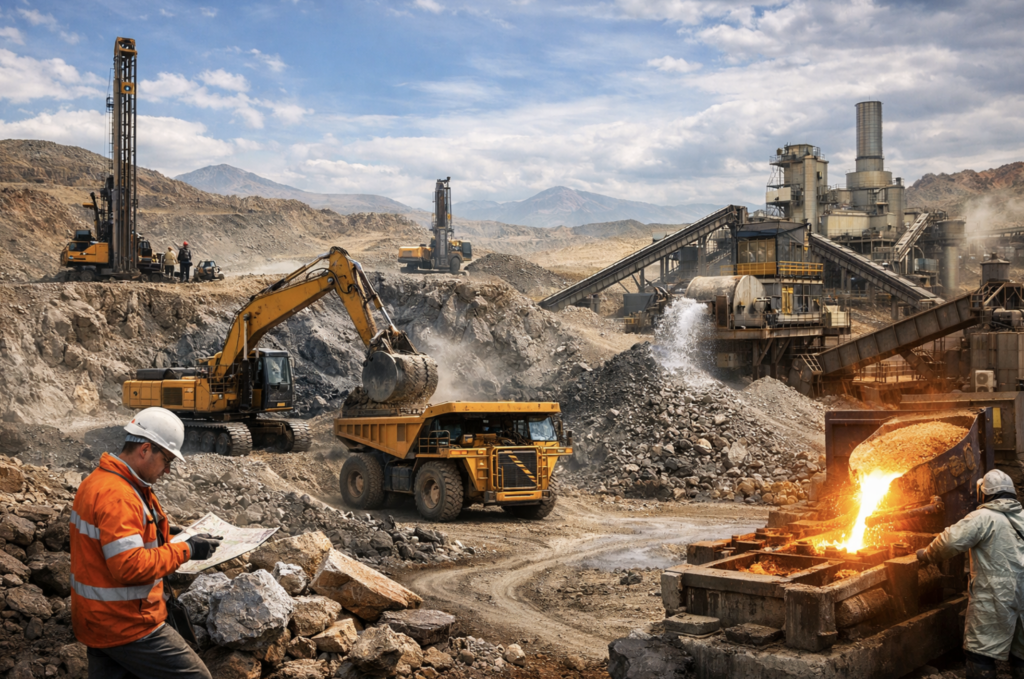
Mining is the set of industrial activities dedicated to extracting minerals and raw materials from the earth through exploration, excavation, crushing and processing operations. It is a fundamental sector for the global economy, as the availability of metals and strategic materials used across multiple industries—from energy and infrastructure to electronics and mobility—depends on these activities.
When we talk about mining activities, we refer to a complex system of operations that includes geological exploration of deposits, material excavation, rock crushing, transportation and subsequent mineral processing. Modern mining is now a highly mechanized industry. Both open-pit and underground mines rely on large-scale machinery operating under extremely harsh conditions, characterized by constant vibrations, heavy loads and challenging environments, often with abrasive dust and significant temperature fluctuations. n this context, equipment reliability is a crucial factor to ensure productivity, safety and operational continuity.
Main stages of mineral extraction
The mining process consists of several operational phases, each requiring specific technologies and dedicated equipment. The first phase is geological exploration, during which mineral deposits are identified and evaluated through geological surveys, geophysical analysis and exploratory drilling. This phase determines the quantity and quality of available resources. Once the deposit is identified, drilling and excavation begin. Open-pit mines use large drilling systems and excavators, while underground mines rely on tunneling techniques.
The extracted material then undergoes crushing and grinding, processes necessary to reduce rock size and facilitate the separation of valuable minerals. This is followed by material transport, carried out using haul trucks, conveyor belts or internal rail systems. Finally, minerals are processed and separated through physical or chemical methods to obtain the mineral concentrate for further industrial use.
Throughout all these stages, machinery is subjected to intense mechanical stress. In mining environments, ground movement—the deformation and shifting of the terrain—is a critical factor affecting equipment stability.
Ground movement and mechanical stress in mining equipment
Ground movement is one of the most significant phenomena in mining operations. Terrain shifts, structural settling and vibrations generated by excavation and transport activities produce substantial mechanical stress on machinery.
This process can be described as a chain of events: ground movement generates vibrations and irregular loads that are transmitted to mechanical structures. Over time, these stresses affect metal components, promoting microfractures and material wear.
As mechanical components deteriorate, they release microscopic metal particles into lubricants used in engines, gearboxes and hydraulic systems. Lubricating oil therefore becomes a valuable source of information about equipment condition. Through oil analysis, early signs of wear can be detected, helping prevent unexpected failures.
Which equipment is most exposed in mining operations
Several types of machinery in the mining sector operate under particularly severe conditions.
Haul trucks, used for transporting material, continuously work under heavy loads and are exposed to constant vibrations due to terrain conditions.
Excavators and loaders are subjected to intense stress on arms, joints and hydraulic systems, which must handle repetitive movements and variable loads.
Crushers and grinding systems operate in highly abrasive environments, where continuous material impact accelerates component wear.
Industrial gearboxes, essential for power transmission in handling systems and conveyor belts, represent another critical point for plant reliability.
Finally, many remote mining sites rely on generators and turbines that must ensure continuous operation in difficult environments.
In all these cases, equipment failure can lead to high operational costs and production downtime.
Applications of oil analysis in mining equipment
In the mining sector, wear metal analysis in lubricating oils is widely used to monitor the condition of key operational machinery. For example, in haul trucks, oil analysis helps detect early wear in diesel engines, transmissions and differentials. In hydraulic systems of excavators and loaders, monitoring metallic elements allows anomalies in pumps and high-pressure circuits to be identified. In gearboxes and crushing systems, wear metals analysis is an effective tool for detecting abrasion and component deterioration.
In this context, oil analysis for mining equipment is one of the most widely used tools in predictive maintenance programs, as it enables early detection of wear before critical failures occur.
In-service oil analysis in the mining sector
In monitoring mining machinery, lubricating oil can be considered a true chemical memory of machine operation. During operation, particles generated by wear of metal components are transported and accumulated in the lubricant. In-service oil analysis is therefore a key predictive maintenance tool. Internationally, this approach is known as oil analysis for mining equipment and is widely used in condition monitoring programs.
A central aspect of this activity is wear metals analysis, which focuses on detecting metals present in the oil. The most important elements monitored include:
- Fe (Iron) → general wear indicator
- Cu (Copper) → bearings and bushings
- Cr (Chromium) → hardened components
- Al (Aluminum) → pistons and lightweight parts
- Na and K → possible coolant contamination
Abnormal increases in these elements represent early indicators of potential mechanical failures.
GNR RotrOil: fast analysis without sample preparation
For elemental analysis of lubricating oils used in industrial machinery, the ideal solution is RotrOil, the Rotrode Emission Spectrometer developed by GNR Analytical Instruments for rapid monitoring of wear metals in lubricants. The instrument is also available in an automated version, R4 RotrOil Automated, particularly suited for mining applications.
RotrOil uses RDE-OES technology (Rotating Disc Electrode – Optical Emission Spectroscopy), a technique designed to directly analyze metals in in-service oils. This system allows fast analysis without any sample preparation, making it ideal for both maintenance laboratories and on-site operational environments where quick results are required.
The technology complies with international standards ASTM D6595 and ASTM D6728, used for monitoring wear metals in lubricants.
RotrOil is widely used in mining oil analysis programs, enabling maintenance teams to quickly detect signs of mechanical deterioration and plan interventions before critical failures occur.
From vibration to chemical data: the value of predictive diagnostics
In mining operations, equipment condition monitoring can be described as a chain of events. Ground movement generates vibrations and irregular loads on mechanical structures. These stresses affect metal components, which over time release particles into lubricants. Through chemical oil analysis, these particles can be detected, transforming an invisible mechanical phenomenon into measurable data.
This approach represents one of the most effective tools for predictive maintenance in mining, enabling early detection of wear, optimized maintenance planning and prevention of unexpected failures.
The future of mining: efficiency, safety and data-driven control
The mining industry is undergoing a major technological transformation. Digitalization and advanced monitoring systems are enabling increasingly efficient management of extraction activities. Key trends include condition-based maintenance, integration of vibration data with chemical lubricant analysis and the development of remote monitoring systems for mining sites in isolated areas.
In this scenario, elemental oil analysis remains one of the key technologies for predictive equipment management. Transforming wear signals into measurable chemical data allows companies to improve plant management, increase operational safety and optimize the performance of mining infrastructure.
FAQ
Mining is the set of industrial activities dedicated to extracting minerals and raw materials from the earth. It includes operations such as geological exploration, drilling, excavation, crushing of materials and the subsequent processing of extracted minerals.
Extractive activities include all operations required to identify, extract and process mineral resources found in the earth. These activities range from deposit exploration to the transportation and processing of materials for industrial use.
Mineral extraction takes place through several operational stages: identification of the deposit, drilling and excavation, rock crushing, material transport and separation of useful minerals. The process can occur in open-pit or underground mines.
The mining sector uses large-scale machinery such as haul trucks, excavators, loaders, crushers, grinding systems, industrial gearboxes and generators. These machines often operate under extreme conditions and must ensure high reliability and continuous performance.
Ground movement, meaning the deformation and shifting of terrain in mining areas, generates vibrations and irregular loads on machinery. These mechanical stresses can cause microfractures and wear phenomena in metal components over time.
In lubricating oil analysis for mining machinery, several wear metals are monitored, including iron (Fe), copper (Cu), chromium (Cr) and aluminum (Al). Elements such as silicon (Si), sodium (Na) and potassium (K) are also analyzed, as they may indicate contamination or operational anomalies.
RDE-OES (Rotating Disc Electrode – Optical Emission Spectroscopy) allows direct analysis of metals present in lubricating oils. Through an electrical discharge between rotating electrodes, the elements in the sample are excited and their concentration is measured using optical emission spectroscopy.
RotrOil is a spectrometer developed by GNR Analytical Instruments for analyzing wear metals in lubricating oils. In the mining sector, it is used to monitor the condition of machinery and support predictive maintenance programs, reducing the risk of failures and minimizing downtime.