
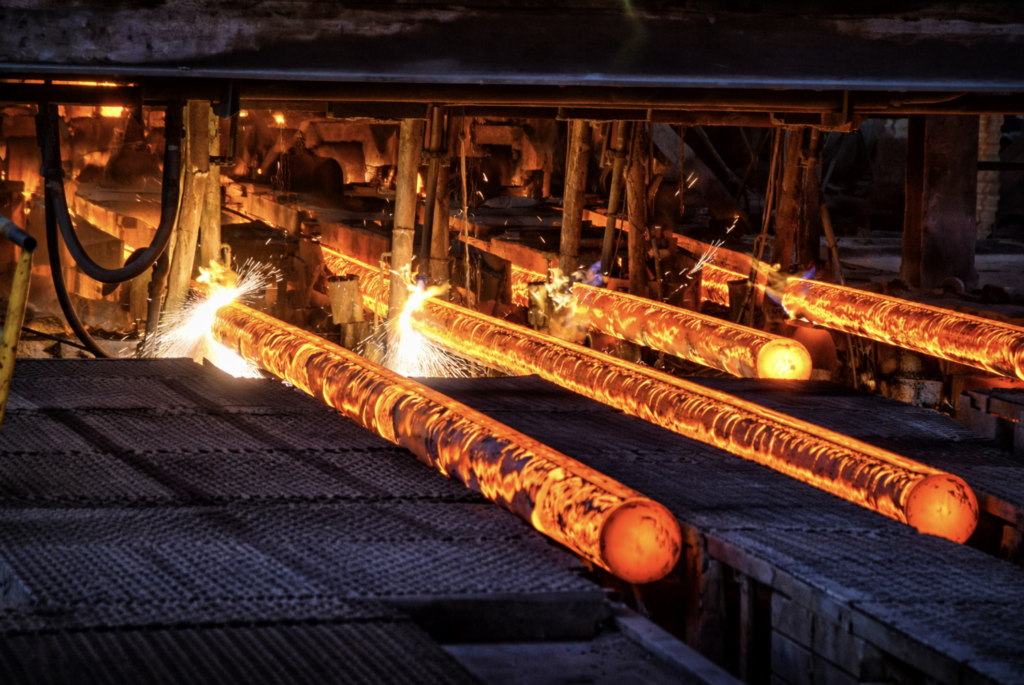
The metallurgical industry is the industrial sector responsible for the production, transformation and refining of metals, from raw material to finished product. It is a fundamental supply chain for the global economy, as almost all infrastructure, industrial machinery, transportation systems and many technological products depend on metals and metal alloys.
What does the metallurgical industry do? The answer involves a complex set of activities, including extracting metal from ore, melting, refining and transforming it into semi-finished or finished products. The sector includes different types of plants and companies: steel mills, foundries, non-ferrous smelters, alloy producers and metallurgical refining plants.
Metallurgical companies operate across the entire production chain, from processing raw metal to manufacturing industrial components. In this context, strict control of chemical composition represents the core of modern metallurgy: even minimal variations in alloying elements can significantly affect mechanical properties, strength and material reliability.
What does the metallurgical industry do along the production chain
The metallurgical industry is structured as a production chain composed of several stages, each characterized by specific technical processes and rigorous analytical controls.
The first stage is primary smelting, where ore is transformed into raw metal through high-temperature processes. At this stage, metal is separated from impurities present in the raw material.
This is followed by refining, which removes additional impurities and precisely adjusts the chemical composition of the metal. This phase is essential for obtaining materials with controlled properties.
Next comes the production of secondary alloys, where specific elements are added to achieve desired properties such as increased mechanical strength, hardness, corrosion resistance or high-temperature stability.
Steel mills and foundries then transform refined metal into semi-finished products, ingots or castings for industrial processing. In non-ferrous metallurgy, specialized plants known as smelters handle materials such as aluminum, copper and nickel.
At every stage, analytical control is essential to ensure mechanical quality, compliance with technical specifications, structural safety and adherence to industrial standards.
What are the main metallurgical processes?
The metallurgical processes involved in metal production are numerous and often integrated along the industrial supply chain.
One of the fundamental processes is reduction, used to extract metal from ore. In traditional steelmaking, this occurs in blast furnaces, while modern technologies may use direct reduction processes (DRI).
Melting brings the metal into a liquid state, enabling impurity separation and further processing.
During refining, unwanted elements are removed and the alloy composition is precisely adjusted.
Continuous casting allows liquid metal to be transformed into solid semi-finished products such as slabs, billets or blooms, which are then processed further.
These processes are complemented by heat treatments, used to modify the microstructure of metals and improve mechanical properties, and by rolling and plastic deformation processes, which shape materials into specific forms and dimensions.
In all these phases, real-time control of chemical composition is a key factor in ensuring material quality.
How many metallurgical industries are there in Italy?
Italy is one of the leading steel producers in Europe and has a highly developed metallurgical industrial system. According to data published by Federacciai, Italian steel production exceeded 20.7 million tonnes in 2025, confirming the strategic importance of the sector for the national economy.
The Italian metallurgical sector consists of a complex network of companies, including large steel groups, highly specialized medium-sized enterprises and numerous foundries with advanced technological expertise. This structure makes Italy one of the most important European countries in metal transformation and the production of special steels.
For further insights, industry data can be consulted through institutional sources and trade associations such as Federacciai, Eurofer and ISTAT.
Chemical control in the modern metallurgical industry
Controlling chemical composition is one of the most critical aspects of the entire metallurgical process. Every metal alloy must meet highly precise compositional specifications to ensure adequate mechanical performance and structural safety.
Chemical analyses are carried out at various stages of production: during primary smelting, refining processes, secondary alloy production, in steel mills and foundries, as well as in non-ferrous metal processing plants.
Among the most commonly monitored elements in metal alloys are carbon (C), silicon (Si), manganese (Mn), chromium (Cr), nickel (Ni), molybdenum (Mo), aluminum (Al), copper (Cu), sulfur (S) and phosphorus (P).
Even very small variations in the concentration of these elements can compromise key properties such as mechanical strength, hardness, toughness and corrosion resistance. For this reason, metallurgical companies use advanced analytical instruments capable of performing fast and precise analysis directly in production environments.
OES spectrometry and GNR solutions for the metallurgical industry
Among the most widely used technologies for metal analysis in the metallurgical industry is Optical Emission Spectrometry (OES).
OES allows the concentration of chemical elements in solid metals to be determined in just a few seconds, enabling fast and accurate control of alloy composition throughout all stages of metallurgical production.
Commonly analyzed elements include carbon (C), silicon (Si), manganese (Mn), chromium (Cr), nickel (Ni), molybdenum (Mo), aluminum (Al) and copper (Cu), along with many other alloying elements essential for defining the mechanical and metallurgical properties of materials.
For this type of analysis, GNR Analytical Instruments develops a complete range of OES spectrometers designed for various industrial environments, from small foundries to large steel plants and quality control laboratories.
Key instruments include S1 MiniLab 150 and S3 MiniLab 300, compact spectrometers designed for metallurgical laboratories and foundries requiring fast and reliable chemical composition control.
For more advanced applications, systems such as S6 Sirius 500 are available, designed for high-precision analysis of both ferrous and non-ferrous materials, along with portable solutions like E3 Esaport and E4 Esaport Plus, ideal for in-production or on-site analysis.
The range also includes S7 Metal Lab Plus and S5 Solaris Plus, designed for industrial laboratories requiring high analytical performance, broad elemental coverage and maximum flexibility.
These spectrometers support foundries, steel plants, mechanical industries and quality control laboratories, enabling fast and reliable analysis directly in production environments and ensuring precise control of metal alloy composition.
Metallurgical industry and ecological transition: the challenge of green steel in Italy and Europe
The metallurgical industry is now at the center of the European ecological transition. Steel and metal production are among the most energy-intensive industrial activities and major contributors to CO₂ emissions, making technological transformation essential.
According to the European Steel Association (EUROFER), the transition to green steel requires coordinated industrial policies at the European level. The organization has called for a “Made in Europe” agreement to support the competitiveness of the European steel industry and reduce the risk of production relocation to countries with less stringent environmental standards.
The WWF has also published reports highlighting the importance of decarbonizing the steel sector in Italy, emphasizing the need to significantly reduce CO₂ emissions through technologies such as process electrification and the use of green hydrogen in ore reduction.
The debate surrounding the decarbonization of former ILVA steel plants represents a concrete example of the complexity of this industrial transformation. Many experts underline the need for a clear long-term strategy for Italian steel production, supported by infrastructure investments, technological innovation and coordinated industrial policies.
The ecological transition of the metallurgical industry is therefore not only an environmental challenge but also a strategic and economic one. New production processes based on electric furnaces, advanced recycling and hydrogen technologies are reshaping the chemical and metallurgical dynamics of production.
In this context, controlling the chemical composition of alloys becomes even more critical. The quality of green steel and new metallic materials increasingly depends on analytical precision and scientific monitoring of production processes.
FAQ
Secondary metallurgy refers to the refining processes applied to molten metal after primary smelting, such as adjusting chemical composition and removing residual impurities to achieve the desired material properties.
The main processes include ore reduction, melting, refining, continuous casting, heat treatments and plastic deformation processes such as rolling and forging, all of which are often integrated within industrial production chains.
The Italian metallurgical sector includes hundreds of companies, ranging from steel mills and foundries to alloy producers, with an annual steel production exceeding 20 million tonnes.
Because even small variations in alloy composition can significantly affect properties such as strength, hardness, toughness and structural safety, making precise control essential for reliable performance.
OES spectrometry analyzes the light emitted by atoms excited during an electrical discharge, allowing rapid determination of the concentration of chemical elements present in the metal.
In the metallurgical industry, Optical Emission Spectrometers (OES), XRF instruments and other analytical technologies are used to quickly and accurately analyze the composition of solid metals.