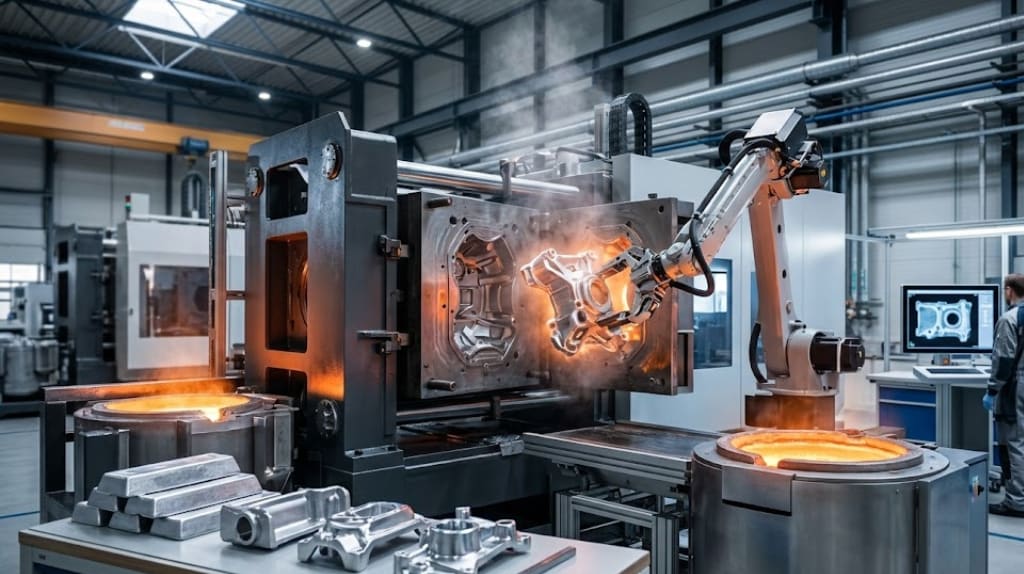
Metal die casting is an industrial casting process in which molten metal is injected at high pressure into a permanent metal mold, known as a die. Once the mold cavity is filled, the material rapidly solidifies and takes the shape of the desired component.
Die casting is one of the most widely used technologies in modern metallurgy for the production of complex metal components with high dimensional accuracy and excellent surface quality. Thanks to the use of reusable metal molds and very fast production cycles, this process is particularly suitable for mass production and high-volume industrial manufacturing.
The technology is widely used to produce components for the automotive, electronics, electromechanical, technical furniture and industrial manufacturing sectors, where lightweight, repeatable parts with complex geometries are required.
One of the main advantages of metal die casting is the ability to produce near-net-shape components directly from the casting process, reducing subsequent machining operations, production times and material waste.
This article explores how the die casting process works, the main production methods, the most commonly used materials, the industrial advantages of the technology and the importance of metallurgical quality control in the management of alloys and finished components.
What Is Die Casting and How Does the Process Work?
Die casting is an industrial casting process used to manufacture metal components by injecting molten metal at high pressure into a permanent metal mold. This technology makes it possible to produce parts with complex geometries, high production repeatability and good surface quality, making it particularly suitable for high-volume manufacturing.
The process consists of several closely controlled stages.
The first stage is metal melting, where the alloy is brought to a liquid state in dedicated furnaces. The melting temperature depends on the type of alloy being used and must be maintained within precise parameters to ensure proper fluidity and metallurgical quality.
Once the correct operating conditions have been reached, the molten metal is transferred to the die casting machine and injected into the mold at high pressure. The pressure allows the material to rapidly fill all sections of the die cavity, even when complex geometries or thin walls are involved.
The molds used in die casting are generally made of permanent steel dies, designed to withstand repeated thermal and mechanical cycles. The use of metal molds enables the production of components with high dimensional accuracy, excellent surface finish and consistent quality from one part to another.
After the cavity has been filled, the metal undergoes rapid solidification. Fast cooling helps reduce cycle times and directly influences the metallurgical structure of the finished component.
Once solidification is complete, the mold opens and the part is automatically ejected through dedicated mechanical systems.
The process is followed by part extraction and finishing, during which runners, flash and process residues are removed through trimming, finishing operations or additional machining when required.
One of the main advantages of die casting is the speed of the production cycle, which makes it possible to manufacture large quantities of metal components while maintaining high repeatability, precision and cost efficiency.
Types of Die Casting
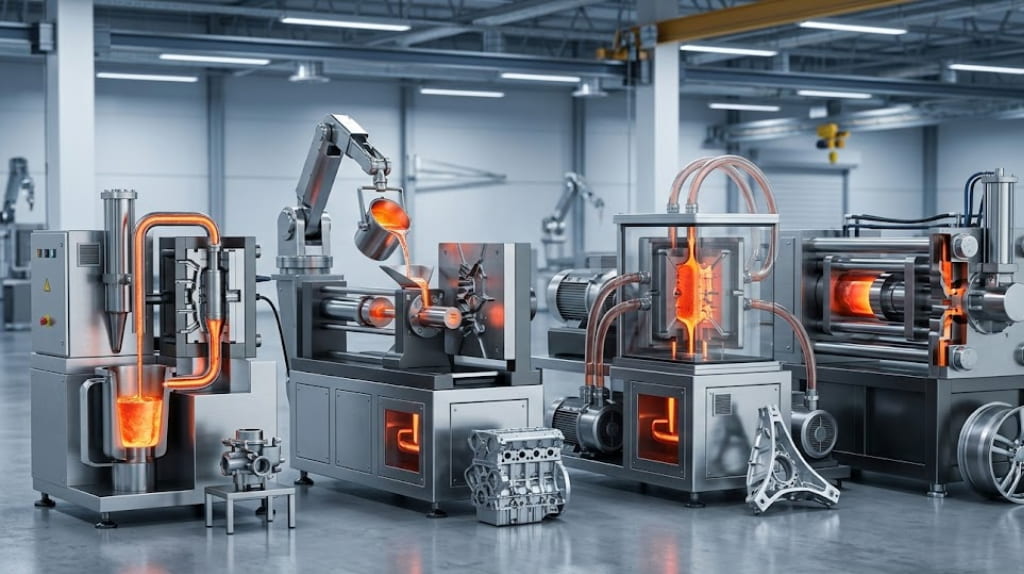
Metal die casting can be performed using different production technologies designed to match the characteristics of the alloys being processed, the size of the components and the performance requirements of the final product.
The main variants differ primarily in the method used to inject the molten metal and in the operating conditions of the process.
One of the most widely used technologies is hot chamber die casting, in which the injection system is immersed directly in the molten metal bath. During the production cycle, the material is drawn into the system and forced into the die through a piston integrated into the machine.
This solution allows extremely fast cycle times and high productivity, making it particularly suitable for low-melting-point alloys such as zinc, magnesium and certain lead alloys. However, the continuous contact between the injection system and the molten metal limits its use with materials that require higher melting temperatures.
For alloys such as aluminum and brass, cold chamber die casting is generally used. In this process, the molten metal is prepared in a separate furnace and then transferred into the injection chamber before being forced into the die at high pressure.
Cold chamber technology makes it possible to process alloys with higher melting temperatures and is widely used in the production of automotive, structural and industrial aluminum components. Compared with hot chamber systems, the process is slightly slower but offers greater metallurgical flexibility.
A more advanced variation is vacuum die casting, in which the air inside the mold cavity is removed before metal injection. This system reduces internal porosity and defects caused by trapped gases during solidification.
Vacuum die casting is mainly used for components that require high mechanical performance, good weldability or subsequent heat treatment, such as structural automotive parts and highly specialized engineering applications.
Another widely used technology in modern manufacturing is High Pressure Die Casting (HPDC). In this process, molten metal is injected into the die at very high speeds and pressures, allowing the production of complex components with thin walls and excellent repeatability.
Today, HPDC is extensively used in the manufacture of aluminum and magnesium components for the automotive, electronics and electric mobility sectors, thanks to its combination of high productivity, dimensional precision and weight reduction.
The choice of the most suitable die casting technology depends on several factors, including the alloy being used, component geometry, required mechanical properties, production volumes and the quality level required for the final part.
Which Metals Are Used in Die Casting?
Among the most widely used materials in industrial die casting are aluminum alloys, which have become one of the most common solutions thanks to their excellent balance of lightweight properties, mechanical strength, workability and corrosion resistance.
Particularly popular are Al-Si (aluminum-silicon) alloys, valued for their excellent castability and their ability to fill complex molds, even when thin-wall sections are involved. Al-Mg (aluminum-magnesium) alloys provide improved mechanical performance and enhanced corrosion resistance, while Al-Si-Cu (aluminum-silicon-copper) alloys are used when a combination of good castability and high mechanical strength is required.
Alongside aluminum, zinc alloys are also widely used, especially in hot chamber die casting processes due to their low melting point and excellent fluidity. Zinc makes it possible to produce highly precise components with excellent surface quality, making it ideal for small technical parts and high-volume manufacturing applications.
Magnesium is another important material used in industrial die casting, particularly in sectors where weight reduction is a strategic requirement, such as automotive and electronics. Magnesium alloys offer an excellent strength-to-weight ratio, although they require more careful process control during production.
In this context, an increasingly important share of industrial production involves the use of secondary aluminum, meaning material obtained through the recovery, recycling and remelting of scrap metal or previously used components.
The use of secondary aluminum has become a key element in the sustainability of the metallurgical industry, as it helps reduce energy consumption, raw material usage and environmental impact compared with primary aluminum production.
However, the management of secondary alloys requires very careful metallurgical control. The chemical composition of recycled material can vary depending on the origin of the scrap and directly affect fluidity, casting behavior, microstructure and the final mechanical properties of the die-cast component.
For this reason, in secondary aluminum die casting, chemical composition control plays a critical role in ensuring production stability, casting quality and compliance with alloy specifications throughout the manufacturing process.
Advantages of Die Casting Technology
Metal die casting is one of the most widely used manufacturing technologies thanks to its ability to combine high productivity, precision and cost efficiency. The process makes it possible to produce complex metal components with short cycle times and excellent production repeatability.
One of the main advantages of die casting is its high productivity. The use of permanent molds and automated production cycles allows manufacturers to produce large quantities of components in a very short time, making the technology particularly suitable for mass production.
Die casting also provides an excellent surface finish, thanks to the precision of metal molds and the rapid filling of the die cavity. In many cases, the resulting components require only minimal finishing operations, offering both technical and economic advantages.
Another key benefit is the dimensional accuracy of the process. Die casting enables the production of components with tightly controlled tolerances and highly complex geometries while maintaining excellent consistency from one part to the next.
The geometric quality of die-cast components often results in a significant reduction in secondary machining operations such as milling, turning or grinding. This helps decrease production times, material consumption and overall manufacturing costs.
Die casting also offers important advantages in structural component design. Through the use of lightweight geometries, ribs and thin-wall sections, it is possible to achieve a better balance between weight and mechanical strength, an aspect that is particularly important in the automotive, aerospace and electronics industries.
From an industrial perspective, all these factors contribute to improving a company’s competitive advantage. Reduced scrap rates, faster production, consistent quality and optimized material usage help improve efficiency, control costs and meet the demands of a market increasingly focused on precision, sustainability and high-volume manufacturing.
Applications of Die Casting in Major Industrial Sectors
Metal die casting is widely used across numerous industries thanks to its ability to produce complex components with high precision, excellent surface quality and outstanding production repeatability. The combination of fast production cycles and cost efficiency makes this technology particularly well suited to high-volume manufacturing.
In the automotive industry, die casting is used to manufacture components such as engine housings, structural supports, transmission cases, chassis components, enclosures and parts for electrical and electronic systems. The use of lightweight die-cast alloys, particularly aluminum, helps reduce vehicle weight while improving energy efficiency and overall performance.
The electronics industry also relies heavily on die casting for the production of enclosures, heat sinks, electronic device components and technical structures that require precise geometries and good thermal conductivity.
In the aerospace sector, die casting is used to manufacture lightweight and complex components for aircraft systems and high-performance applications. The technology makes it possible to achieve optimized geometries and weight reduction while maintaining excellent mechanical properties.
Die casting is also widely employed in the production of household appliances, where it is used to manufacture structural components, supports, housings, functional parts and metal components produced in large industrial volumes.
In the industrial machinery sector, die-cast components are used in automated systems, motors, pumps, gearboxes, manufacturing equipment and technical structures that require dimensional accuracy and consistent production quality.
One of the main reasons for the widespread adoption of die casting is its ability to support highly repeatable mass production. The use of permanent molds, automated processes and rapid production cycles makes it possible to manufacture large quantities of components with highly consistent characteristics while reducing processing times, production costs and the need for secondary machining operations.
Chemical Composition Control in Aluminum Alloy Die Casting
In aluminum alloy die casting, controlling the chemical composition of the alloy is one of the most important factors in ensuring casting quality, production stability and process repeatability. Even small variations in alloy composition can significantly affect material behavior during casting and the final properties of the die-cast component.
Particular attention is paid to Al-Si (aluminum-silicon) alloys, which are among the most widely used materials in die casting due to their excellent fluidity and ability to fill complex molds. The silicon content directly influences castability, microstructure formation and the behavior of the casting during solidification.
The control of Al-Mg (aluminum-magnesium) alloys is equally important, especially in applications requiring higher mechanical strength and improved corrosion resistance. Magnesium content must be maintained within very tight limits to avoid changes in metallurgical properties and production instability.
Another increasingly important aspect is the management of secondary alloys, obtained through aluminum recovery, recycling and remelting processes. The use of secondary aluminum has become a strategic solution from both economic and environmental perspectives, but it requires highly accurate chemical control to ensure compositional consistency and material quality.
For this reason, in industrial die casting, chemical composition is verified before casting begins, ensuring that the alloy contains the correct concentrations of elements specified by production requirements.
Even minor compositional variations can affect critical process parameters such as molten metal fluidity, porosity formation, solidification behavior and material shrinkage within the mold.
Chemical composition also has a direct impact on the final mechanical properties of the component, influencing strength, hardness, fatigue performance and long-term operational reliability.
To ensure production consistency and quality control, manufacturers use OES spectrometric analysis systems, which enable rapid verification of aluminum alloy composition throughout every stage of production.
In a highly automated process such as die casting, chemical composition control is therefore essential for maintaining high production repeatability, reducing defects and ensuring consistent quality in finished components.
GNR Instruments for Quality Control in Die Casting
In the metal die casting industry, fast and accurate control of alloy chemical composition is essential to ensure casting quality, production stability and the reduction of metallurgical defects. In particular, for aluminum alloy die casting, composition monitoring is critical for controlling parameters such as fluidity, porosity, shrinkage and the final mechanical properties of the component.
To support these requirements, GNR offers a complete range of OES (Optical Emission Spectrometry) spectrometers designed for metallurgical control in foundries, steel plants and metal processing industries.
GNR instruments enable rapid verification of alloy composition before casting, during molten metal management and in final quality control of die-cast components. This makes it possible to identify compositional variations that could compromise process stability or the quality of the finished part.
For laboratory activities and routine quality control, GNR provides compact solutions such as the S1 MiniLab 150 and S3 MiniLab 300, suitable for the rapid analysis of ferrous and non-ferrous materials and for routine testing in industrial production environments.
The S6 Sirius 500, featuring CMOS technology and EOS software, is designed for advanced applications requiring high analytical speed, broad elemental coverage and precise control of the aluminum alloys commonly used in die casting.
For inspections directly on the production floor or on materials that are difficult to move, the portable E3 Esaport and E4 Esaport Plus spectrometers allow rapid alloy verification and material sorting operations to be carried out directly in production areas.
In more advanced industrial environments, such as foundries and high-volume manufacturing facilities, instruments such as the S5 Solaris Plus and S7 Metal Lab Plus provide highly accurate metallurgical control and in-depth verification of secondary alloys and materials intended for die casting applications.
Thanks to OES spectrometry, GNR instruments help die casting manufacturers maintain production repeatability, reduce scrap rates and ensure metallurgical quality throughout every stage of the industrial process.
Recent Innovations in Aluminum Die Casting
Metal die casting is evolving rapidly thanks to the introduction of digital technologies, advanced simulation tools and new manufacturing approaches focused on producing larger, lighter and more complex components. In this context, process innovation and metallurgical control are becoming increasingly interconnected.
One of the most significant developments in recent years is automotive giga casting, a technology that enables the production of large structural aluminum components through a single high-pressure casting operation.
A study published in the Journal of Manufacturing Processes examines the impact of giga casting on automotive manufacturing, highlighting benefits such as a reduced number of assembled components, structural weight reduction and simplified production lines.
However, the production of large castings introduces new metallurgical and thermal challenges. In giga casting processes, the management of Al-Si alloys requires extremely precise control of chemical composition and cooling conditions in order to prevent porosity, residual stresses, internal defects and microstructural variations throughout the component.
As casting size increases, alloy monitoring before pouring and throughout the production process becomes even more important, since even minor compositional variations can affect material fluidity, solidification behavior and final mechanical properties.
Another rapidly growing area of innovation is the use of CFD (Computational Fluid Dynamics) and FEM (Finite Element Method) simulations in die casting operations.
Research published in the journal Metals (MDPI) shows how modern simulation techniques are used to analyze molten metal flow inside the die and predict potential issues before actual production begins.
These tools make it possible to simulate mold filling, turbulence, gas entrapment, inclusions and the formation of metallurgical defects, helping manufacturers optimize component geometry, injection parameters and thermal conditions.
As a result, simulation technologies reduce development times, minimize production scrap and improve both quality and repeatability in industrial die casting processes.
However, even the most advanced simulation systems require accurate metallurgical data to deliver reliable results. For this reason, process innovation must be supported by precise control of alloy composition. OES spectrometry plays a key role in this context, providing rapid and accurate verification of alloy chemistry before casting and throughout production, helping manufacturers maintain process stability, reduce defects and ensure consistent quality in die-cast aluminum components.
FAQ
Die casting is a casting process in which molten metal is injected at high pressure into a permanent metal mold. After the die cavity is filled, the material rapidly solidifies and takes the shape of the desired component. The process is particularly suitable for high-volume production thanks to its fast cycle times, high dimensional accuracy and excellent production repeatability.
In hot chamber die casting, the injection system is immersed directly in the molten metal bath and is mainly used for low-melting-point alloys such as zinc and magnesium. In cold chamber die casting, the molten metal is transferred from a separate furnace to the injection system before being forced into the die. This technology is particularly suitable for aluminum alloys and other materials with higher melting temperatures.
A die-cast metal component is a metal part manufactured through the die casting process. The component is produced by injecting molten metal into a metal die at high pressure, resulting in parts with precise geometries, good surface finish and highly repeatable dimensional characteristics.
In aluminum alloy die casting, chemical composition directly affects molten metal fluidity, solidification behavior, porosity formation, shrinkage and the final mechanical properties of the component. Even small variations in elements such as silicon, magnesium or copper can influence both product quality and process stability.
Before casting, metallurgical inspections and chemical composition analyses are carried out to ensure that the alloy meets the required specifications. These controls help prevent production defects, process instability and variations in the mechanical properties of the finished component.
An OES spectrometer is used to analyze alloy composition before casting, during molten metal management and during final quality control of die-cast components. Spectrometric analysis enables rapid verification of alloy compliance and helps identify compositional variations that could affect fluidity, solidification behavior and the overall metallurgical quality of the casting.