
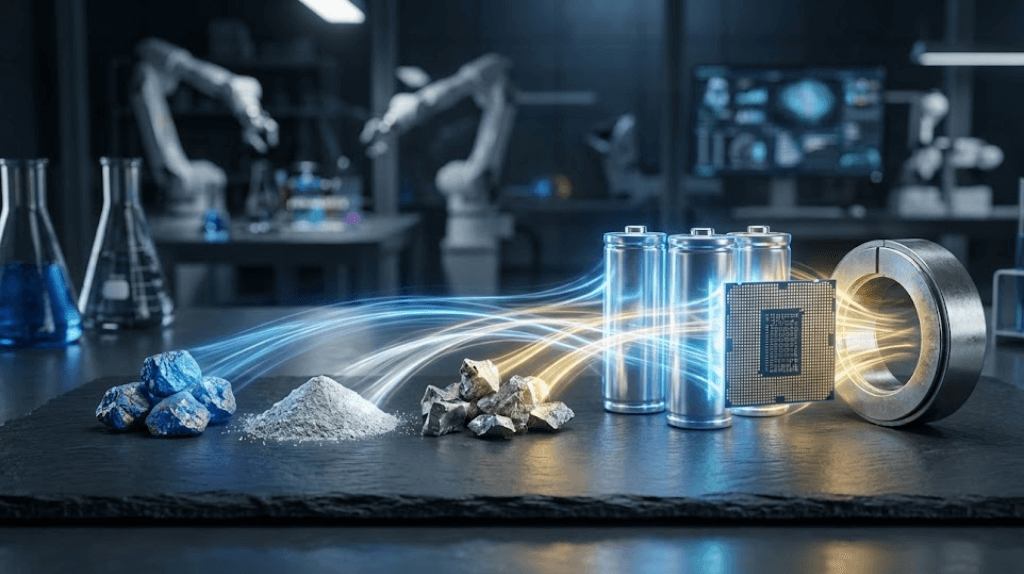
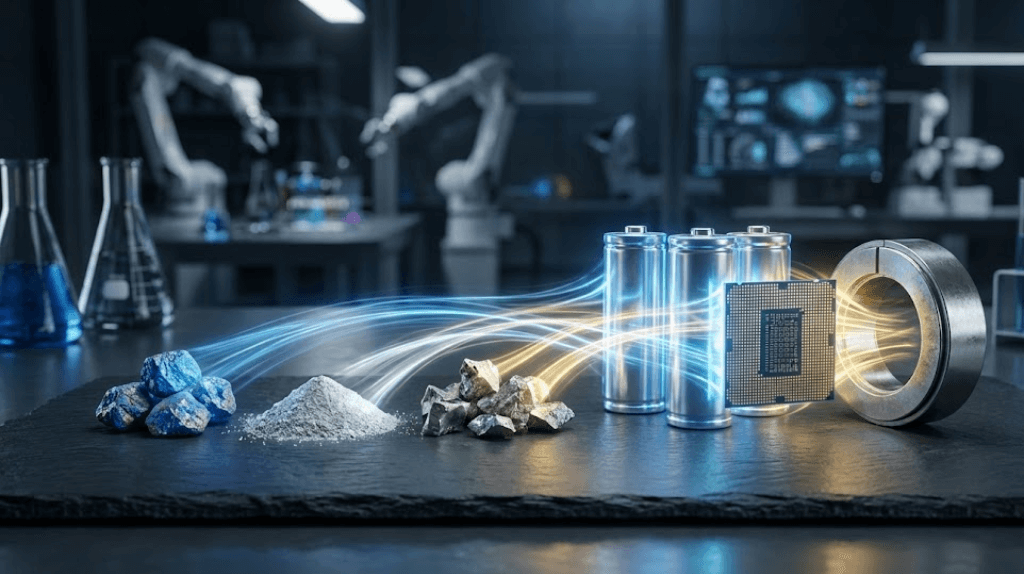
Critical raw materials are not a theoretical concept or a distant policy issue: they directly impact real companies, industrial investments and strategic supply chains. Talking about critical raw materials means talking about competitiveness, innovation and supply security.
From the energy transition and battery production to electronics and semiconductors powering the digital economy, and from defense to aerospace and electric mobility, entire industrial value chains depend on materials such as rare earths, lithium, nickel, cobalt, gallium and germanium. Telecommunications infrastructure and network technologies also rely on specialty metals essential for efficiency, signal stability and miniaturization.
In all these sectors, the availability and quality of critical raw materials are not merely supply concerns, but strategic factors influencing performance, sustainability and global competitive positioning.
Critical Raw Materials: Definition and Classification Criteria
According to the European Union, a raw material is considered “critical” when it combines two decisive factors: high economic and technological importance and a significant risk of supply disruption.
On the one hand, these materials are essential for key technologies related to the green and digital transition, as well as for strategic sectors such as defense and aerospace. On the other hand, they are exposed to supply risks due to the strong geographical concentration of extraction, the concentration of refining and processing activities in a limited number of countries, heavy import dependence and potential geopolitical or trade instability affecting supply chains.
With the Critical Raw Materials Act (Regulation EU 2024/1252), the European Union has identified 34 critical raw materials, of which 17 are considered strategic for the energy transition, digital transformation and industrial security.
Source: Council of the European Union – Critical Raw Materials
Examples of Critical Raw Materials
Among the main critical raw materials included in the official EU lists are:
- Rare earth elements (REEs) – essential for permanent magnets, wind turbines, electric motors and advanced electronics.
- Lithium – a key element in lithium-ion batteries for electric vehicles and energy storage systems.
- Cobalt – used in batteries, high-performance alloys and aerospace applications.
- Nickel – crucial for batteries and specialty steels.
- Graphite – a core component in battery anodes.
- Tungsten – used in high-resistance tools, electronics and defense applications.
- Gallium and Germanium – employed in semiconductors and advanced electronic technologies.
These materials are often invisible to end users, yet indispensable for smartphones, electric vehicles, photovoltaic systems, wind turbines, semiconductors and defense systems.
Rare earths, discussed in detail in a previous article, represent a clear example of a critical raw material: extremely high technological relevance combined with strong global production concentration.
Why Critical Raw Materials Matter for Industry and the Economy
Critical raw materials are a pillar of European industrial competitiveness. Without them, the energy and digital transition would not be achievable.
Energy transition: Batteries, photovoltaic panels, wind turbines and storage systems depend on lithium, nickel, rare earths and other strategic metals.
Electronics and digitalization: Smartphones, computers, semiconductors and digital infrastructures require elements such as gallium, germanium and rare earths.
Defense and aerospace: High-performance alloys, radar systems and advanced electronic components rely on tungsten, cobalt and other critical materials.
Electric and hybrid mobility: The automotive sector is one of the largest users of critical raw materials, particularly for batteries, electric motors and permanent magnets.
Critical Raw Materials in Italy: Current Situation and Future Developmen
Italy does not have a significant domestic production of critical metals and largely depends on imports. However, recent analyses indicate the presence of deposits containing materials included in the EU list of critical raw materials.
According to ISPRA (Italian Institute for Environmental Protection and Research), several Italian mining sites contain substances classified among the 34 EU critical raw materials, such as fluorite and feldspar.
Alongside primary extraction, increasing attention is being given to:
- critical material recycling projects
- development of alternative supply chains
- research on substitute materials
- strengthening analytical and material characterization capabilities
Recycling batteries and electronic waste represents a strategic opportunity to reduce external dependence and enhance existing resources within the industrial system.
GNR’s Role in Metal Analysis for Critical Raw Materials
In a context where critical raw materials are central to industrial competitiveness, the ability to accurately determine their chemical composition becomes a strategic factor.
Metal analysis through advanced spectrometers is a key tool for the rapid and accurate determination of the composition of metals and alloys containing critical elements. By enabling the simultaneous identification and quantification of multiple elements, including rare and noble metals, spectrometers for metal analysis support quality control, traceability and efficient resource management.
In particular, metal analysis using optical emission spectrometry (OES) enables reliable operation in the main application areas related to critical raw materials, ensuring precision, repeatability and speed in industrial processes, including:
- Scrap control and recycling – rapid identification of alloy composition for efficient recovery of strategic metals.
- Rare earth analysis (REEs) – detection and quantification in complex metallic matrices.
- Platinum group metals (PGMs) – quantitative analysis in refining and recovery processes.
- High-performance alloys – verification of critical materials used in electric automotive, aerospace and defense industries.
The advantages of optical emission spectrometry include:
- Speed – results in seconds, ideal for process control.
- Multi-element capability – simultaneous determination of dozens of elements.
- Precision and accuracy – reliable performance even at low concentration levels.
In a European framework characterized by import dependency and growing technological demand, precise analytical techniques allow industries to correctly classify materials, enhance recycling efficiency and ensure quality across the entire supply chain.
FAQ – Critical Raw Materials
Critical raw materials are materials of high economic and technological importance that face significant risks of supply disruption. They are essential for strategic sectors such as renewable energy, electronics, automotive, defense and aerospace.
The European Union has identified 34 critical raw materials under the Critical Raw Materials Act, including rare earths, lithium, nickel, cobalt, graphite, tungsten, gallium and germanium.
Rare earths are essential for permanent magnets, wind turbines, electric motors and advanced electronic devices. Their production and refining are highly concentrated in a limited number of countries, increasing supply risks.
Key sectors include renewable energy, electric mobility, electronics and semiconductors, defense, aerospace and telecommunications.
Critical raw materials are analyzed using metal characterization techniques such as optical emission spectrometry (OES), ICP-OES and X-ray-based analytical technologies. These methods allow precise determination of composition, purity and trace elements, supporting quality control and R&D activities.